Fillmore Days: Where History Meets Celebration at Fillmore Glen State Park
There are summer weekends when Fillmore Glen State Park is a place for waterfalls, shaded trails and family picnics. And then there is Fillmore Days—when history, community tradition and a wonderfully unusual form of racing come together in Moravia.
For generations, Fillmore Glen has been one of the community’s great gathering places. But during Fillmore Days, the park becomes something more: a celebration of Moravia itself.
And if there is one tradition that captures the personality of the weekend, it is the bathtub races.
A Celebration With Deep Local Roots
Fillmore Days draws its identity from the place where it is held.
Fillmore Glen State Park is one of the Finger Lakes region’s most intimate state parks, a narrow wooded gorge carved by flowing water and punctuated by waterfalls, stone stairways, bridges and pools.
The park is named for Millard Fillmore, the 13th president of the United States, who was born in 1800 in a log cabin a few miles east of present-day Moravia.
Fillmore’s beginnings were modest. Born into a farming family on what was then the New York frontier, he received relatively little formal schooling. Through self-education and the study of law, he eventually entered politics and rose to the presidency.
Whatever one’s assessment of Fillmore’s complicated political legacy, his beginnings remain firmly connected to this corner of Cayuga County.
During Fillmore Days, however, history isn’t something confined to a marker or display.
It becomes part of a living community celebration.
Then Come the Bathtubs
You could hold a race almost anywhere.
But it takes a certain kind of community to look at a bathtub and think:
We should race that.
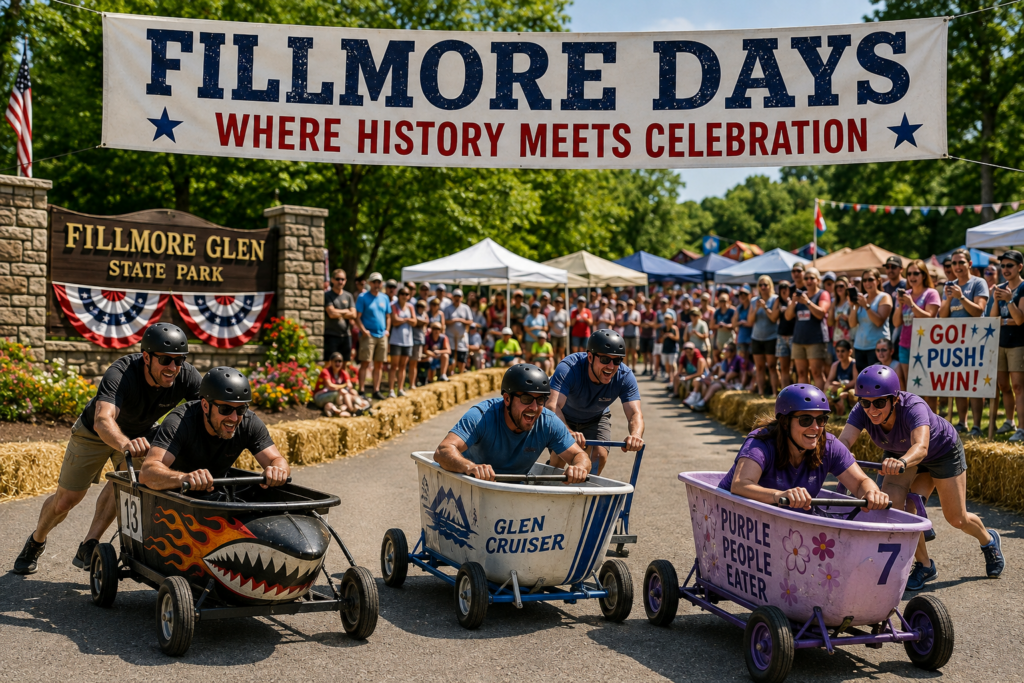
That spirit is at the heart of one of Fillmore Days’ most memorable traditions—the bathtub races.
The concept is wonderfully simple and just unusual enough to make it unforgettable. Teams bring their racing creations, spectators gather to watch, and ordinary bathtubs are transformed into unlikely racing machines.
Speed matters.
So does teamwork.
But spectacle is certainly part of the attraction.
There is something irresistibly small-town about the whole thing. It is competitive without taking itself too seriously, traditional without being formal, and entertaining whether you’ve watched the races for years or have just discovered them.
The crowd becomes part of the event as teams push toward the finish, encouragement rises from spectators and the outcome can remain uncertain until the final moments.
For visitors encountering Fillmore Days for the first time, the bathtub races often produce the inevitable question:
“They race what?”
Exactly.
And that’s why people remember them.
A Tradition That Belongs to Moravia
Plenty of communities have summer festivals.
What makes the best ones special are the traditions that couldn’t simply be picked up and moved somewhere else.
The bathtub races have become one of those traditions.
They’re quirky. They’re fun. And most importantly, they’re local.
In an era when festivals can sometimes begin to feel interchangeable, traditions like this give Fillmore Days an identity of its own. They provide the stories that get retold later—the close finish, the particularly creative bathtub, the team that nearly had it won or the race everyone was certain would end differently.
Those stories accumulate.
Eventually, they become part of community history themselves.
The Glen Behind It All
Beyond the festivities waits the landscape that has drawn people here for generations.
Fillmore Glen’s gorge is dramatically different from the open farmland surrounding Moravia. Step onto the trails and the environment quickly changes.
Trees close overhead.
The temperature seems to drop.
Water echoes between steep rock walls.
Trails wind past waterfalls and pools while bridges and stonework lead visitors deeper into the gorge.
For families attending Fillmore Days, that creates an unusual combination. A morning or afternoon of community activities can easily become a hike through one of Central New York’s beautiful natural areas.
The festival and the park complement one another.
One celebrates the community.
The other helps explain why generations have chosen to gather here.
The Familiar “Cow Sheds”
Longtime visitors will also recognize one of Fillmore Glen’s most familiar features—the rustic shelters commonly known locally as the “cow sheds.”
They aren’t grand monuments, and that is precisely why they matter.
Places like these become landmarks through repetition. Family reunions, picnics, community gatherings and summer afternoons turn ordinary structures into repositories of memory.
Someone visiting for the first time may simply see a row of shelters.
Someone who grew up around Moravia may see decades.
That sense of familiarity runs throughout Fillmore Days. Much of its appeal comes not from creating something new each year, but from returning to something people already share.
Generations Meeting in the Same Place
Walk around Fillmore Glen during the celebration and you’ll see something increasingly valuable in small communities: generations occupying the same space.
Children experience traditions their parents remember.
Neighbors who may not see one another regularly stop and talk.
Former residents return.
Visitors discover Moravia.
And somewhere amid all of it, another group prepares to send a bathtub racing toward the finish line.
It’s difficult to manufacture that kind of community character.
It develops slowly, through repetition.
One summer becomes ten summers. Ten become twenty. Eventually, an event stops being simply something that happens on the calendar.
It becomes part of how a community remembers itself.
More Than a Day at the Park
Fillmore Days also demonstrates the potential of local heritage.
Moravia already has the pieces many communities try to create: presidential history, a remarkable state park, waterfalls, rural scenery and traditions with genuine local roots.
The opportunity is to connect them.
Someone who comes to see the bathtub races might discover the gorge.
Someone hiking at Fillmore Glen might wander into the celebration.
A family visiting from elsewhere might continue into the village, discover Main Street and leave knowing considerably more about Moravia than they expected when the day began.
That is community tourism in its most natural form.
It doesn’t require turning Moravia into something it isn’t.
It requires celebrating what it already is.
Where History Meets Celebration
Eventually the races end.
Families begin packing up. The crowds thin. Conversations wind down.
And Fillmore Glen slowly becomes a quiet state park again.
Water continues through the gorge.
The waterfalls keep falling.
The trails disappear beneath the trees.
But another chapter has been added to a tradition that belongs unmistakably to Moravia.
Fillmore Days works because it combines two kinds of history.
There is the history preserved in the landscape and in the story of Millard Fillmore.
And then there is the history residents create themselves—one gathering, one summer and, yes, one racing bathtub at a time.
That’s the charm of Fillmore Days.
History provides the setting. Community provides the celebration. And the bathtub races make sure nobody forgets it.