
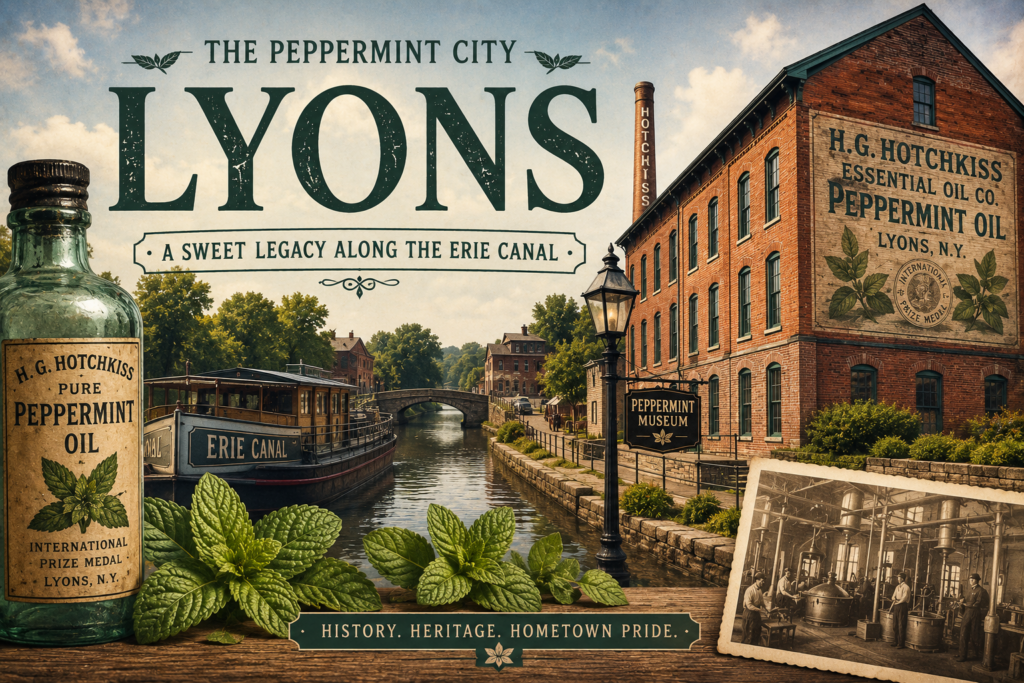
The Peppermint City
How Lyons, New York, Sent a Finger Lakes Crop Around the World
By 11 Lakes Magazine
Drive through Lyons today and it is easy to see the fingerprints of history.
The Erie Canal passes through the community. Historic buildings recall a time when canal towns were centers of commerce, carrying the products of Upstate New York toward distant cities and ports.
But there was once something else in the air here.
Peppermint.
For generations, this Wayne County community was associated with an agricultural industry that reached far beyond the fields surrounding the village. Peppermint grown in the region was distilled into intensely aromatic oil, packaged in Lyons and shipped to customers around the world.
The industry became so important that Lyons acquired a nickname it still carries today:
The Peppermint City.
When Peppermint Became a Cash Crop
During the 19th century, the rich agricultural soils of Wayne County proved well suited to peppermint.
By the 1840s, farmers were increasingly cultivating mint as a commercial crop. The plants themselves were valuable, but the real prize was what could be extracted from them.
Peppermint oil.
Harvested mint could be placed into stills and subjected to steam distillation, separating its valuable essential oil from the plant material.
A field crop had suddenly become a concentrated commodity.
And one Lyons businessman recognized its potential.
His name was Hiram Gilbert Hotchkiss.
Hotchkiss became one of the central figures in the development of the region’s peppermint industry. What began as a local agricultural enterprise grew into a sophisticated business based on quality, branding and international trade.
The timing could hardly have been better.
A transportation revolution was passing directly through town.
The Canal Changes Everything
The Erie Canal reached Lyons in the early 1820s.
Its arrival transformed what was possible for farmers and manufacturers throughout the region.
Before the canal, moving agricultural products overland was slow and expensive. The new waterway connected communities across Upstate New York with Albany and, from there, the Hudson River and New York City.
Suddenly, a product made in a small Wayne County community could enter national and international markets.
Peppermint oil was particularly well suited to that new economy. Unlike bulky agricultural commodities, the concentrated oil was valuable in relatively small quantities and could travel great distances.
Hotchkiss understood the opportunity.
In 1839, a sample of his peppermint oil was reportedly sent to Hamburg, Germany, where its quality helped establish an international reputation for the Lyons product.
Soon the name Hotchkiss meant something far beyond Wayne County.
Peppermint from the fields of Upstate New York was becoming a global commodity.
The Smell of an Industry
Imagine Lyons during the height of peppermint production.
Farmers brought harvested mint from the surrounding countryside. Distillation converted mountains of green plant material into small quantities of valuable oil. Bottles and containers were prepared for shipment.
And through the center of it all ran the canal.
The relationship between agriculture, industry and transportation was remarkably direct.
The fields supplied the mint.
Lyons distilled and marketed the oil.
The Erie Canal carried it toward the world.
By the latter part of the 19th century, peppermint had become deeply intertwined with the local economy. A large portion of the surrounding farming community participated in growing, processing or supplying the industry.
Lyons wasn’t simply producing peppermint oil.
It had built an identity around it.
The Hotchkiss Name Goes International
The Hotchkiss enterprise became known for emphasizing purity and quality.
Its peppermint oil received recognition at major exhibitions, helping establish the product as a premium commodity in international markets.
Awards and medals became part of the company’s marketing. Bottles and packaging proudly advertised the recognition the oil had received.
This was sophisticated branding long before anyone used the term.
A customer purchasing Hotchkiss peppermint oil wasn’t simply buying an agricultural extract from New York.
They were buying a product with a reputation.
And that reputation had been created in Lyons.
Inside the Peppermint Works
The physical heart of the business was the H.G. Hotchkiss Essential Oil Company.
The surviving plant on Water Street dates to the 1880s, built on the site of earlier peppermint operations.
For decades, this was where agriculture became industry.
Distillation equipment processed peppermint. Oil was handled, bottled and prepared for sale. Packaging carried the Hotchkiss name far beyond the village.
Today, the historic property survives as the H.G. Hotchkiss Peppermint Museum, preserving artifacts from an industry that once made Lyons internationally known.
Original equipment, bottles, labels and other materials help tell a story that otherwise might be difficult to imagine.
A quiet building along the canal was once connected to customers thousands of miles away.
The historic Hotchkiss plant was added to the National Register of Historic Places in 1987, recognizing its importance to American industrial and agricultural history.
Success Wasn’t Always Simple
Like many family businesses, the Hotchkiss enterprise had its share of internal disagreements.
Hiram worked with his brother Leman, and although the family helped build a remarkably successful peppermint business, historical accounts document tensions and eventual changes in their business relationship.
It is a useful reminder that the polished labels and international medals tell only part of the story.
Behind successful enterprises are people.
They disagree.
They take risks.
They make mistakes.
They compete.
And sometimes they build something much larger than they initially imagined.
Whatever their differences, the Hotchkiss family helped turn Lyons peppermint into a product recognized far beyond New York.
When the Peppermint Fields Disappeared
No agricultural industry remains unchanged forever.
Peppermint production gradually shifted to other parts of the country where growing conditions, land availability and agricultural economics favored larger-scale production.
The industry that had helped define Lyons diminished.
Eventually, commercial Hotchkiss operations left the community in 1990.
After roughly a century and a half, Lyons was no longer a center of the peppermint-oil business.
But something interesting happened.
The peppermint didn’t entirely disappear.
It became history.
And history became identity.
A Town Remembers
Lyons continues to embrace its unusual place in agricultural history.
The nickname Peppermint City remains part of the community’s identity, while local historical collections preserve the equipment, bottles, advertisements and stories associated with the industry.
Community celebrations have also kept the peppermint tradition alive.
What was once an everyday part of the local economy has become something worth deliberately remembering.
That transition happens throughout the Finger Lakes.
Mills become museums.
Railroad depots become community spaces.
Canal warehouses find new purposes.
Farm equipment becomes historical artifacts.
Industries disappear, but their influence remains embedded in the communities they helped build.
More Than Peppermint
The story of Lyons is ultimately about much more than an herb.
It is a story about the extraordinary transformation of Upstate New York during the 19th century.
Agriculture met industry.
Small-town entrepreneurs discovered international markets.
The Erie Canal connected rural communities with the world’s great commercial centers.
And a crop growing in Wayne County soil became a product known thousands of miles away.
Today, travelers may pass through Lyons without realizing any of this.
They may see the canal.
They may notice the historic buildings.
They may stop for lunch and continue toward the next Finger Lakes destination.
But look a little closer and another story appears.
A story of farmers and stills.
Of bottles and boats.
Of entrepreneurship, family ambition and international commerce.
And of a small canal community that once helped make the world smell a little more like peppermint.
In Lyons, history doesn’t just have a story.
It has a scent.