
Where Water Wrote the Landscape
Just outside Ithaca, Enfield Creek has spent thousands of years carving a passage through stone. Robert H. Treman State Park lets visitors walk directly into that story.
There is a moment on the trail at Robert H. Treman State Park when the outside world seems to disappear.
The traffic is gone. The open farmland and neighborhoods around Ithaca have slipped behind the trees. Ahead, the gorge narrows, the temperature drops, and the sound of water begins to overpower everything else.
Then comes the first glimpse of the stone walls of Enfield Glen.
This is the Finger Lakes beneath the postcard scenery — not the broad blue water, vineyards and rolling hills most often associated with the region, but something older, darker and considerably more dramatic.
Here, the landscape closes in.
And the water takes over.
A Gorge Built One Drop at a Time
Robert H. Treman State Park occupies more than simply a scenic piece of land southwest of Ithaca. Its centerpiece, Enfield Glen, is a geological record written in shale, sandstone and moving water.
The rocks exposed within the gorge date back roughly 380 million years, to the Devonian Period. The landscape visitors see today took shape much later. As the last glaciers retreated from the Finger Lakes roughly 10,000 years ago, streams began cutting through the newly exposed and steepened terrain.
Enfield Creek has been working on the gorge ever since.
The result is one of the region’s great waterfall landscapes.
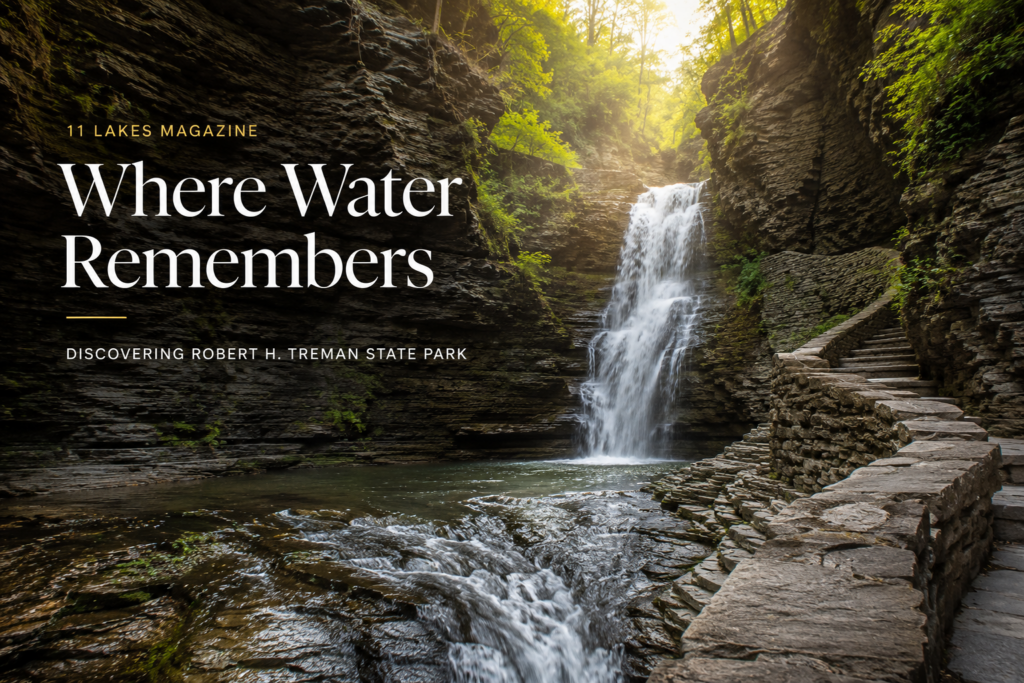
The park contains 12 waterfalls, with trails following the creek through a gorge that changes character as hikers move between the upper and lower sections.
But numbers don’t adequately describe the experience.
Walking Treman is an exercise in watching water reshape a landscape in real time.
Pools collect beneath ledges. Water slips through narrow channels and tumbles over shelves of rock. Fallen trees become temporary dams. Moss finds a foothold in shaded crevices.
And around the next bend, the entire scale of the gorge changes.
Lucifer Falls
Eventually, nearly every conversation about Treman arrives at the same place.
Lucifer Falls.
At 115 feet, it is the park’s signature waterfall, descending in a broad staircase of water through the upper gorge.
The name suggests something fierce, and after heavy rain the falls can certainly live up to it. But in lower water, Lucifer Falls reveals another personality. Water spreads across the rock face, breaking into ribbons before gathering again below.
The best views are not necessarily the quickest ones.
The trails climb and turn around the gorge, revealing the falls from different elevations. From above, the creek appears almost deceptively small before beginning its descent. From farther down the gorge, the waterfall becomes part of a much larger composition of cliffs, forest and water.
It is the kind of place that rewards stopping.
The photograph can wait.
Before the Park, There Was a Community
Treman’s story is not entirely geological.
Near the park’s upper entrance stands an old stone mill, a reminder that this seemingly wild gorge was once part of a working community.
The mill was built in 1839 and became a center of the former hamlet of Enfield Falls. Today it helps tell the story of the people who lived and worked beside the creek long before hikers arrived with backpacks and cameras. Interpretive materials around the mill document the milling operation and remnants of the former settlement, including homes and a hotel.
That history changes the way the park feels.
The stone walls, old foundations and mill are reminders that the Finger Lakes landscape has rarely been simply wilderness. Generations have farmed it, harnessed its streams, built communities beside it and eventually made deliberate choices to preserve portions of it.
Robert H. Treman was one of the people who helped make that preservation possible.
The park that carries his name became part of the developing New York State park system, protecting a gorge that might otherwise have followed a very different path.
Later, during the Depression era, Civilian Conservation Corps workers contributed to the park’s development — another layer of history now interpreted inside the Old Mill.
The trails visitors walk today therefore tell two stories at once: one created by nature and another shaped by people.
The Long Way Is the Point
There are easier ways to see a waterfall.
That isn’t really what Treman is about.
The park has roughly nine miles of hiking trails, and the experience changes considerably depending on where a visitor begins.
The Gorge Trail provides the intimate experience — stone walls, waterfalls, creek crossings and staircases.
The Rim Trail offers perspective.
From higher ground, hikers begin to understand the scale of Enfield Glen and how deeply a relatively modest creek has cut into the surrounding landscape.
Taken together, the trails turn Treman from a waterfall stop into a journey.
That distinction matters.
The Finger Lakes are filled with scenic overlooks where visitors can park, take a photograph and leave ten minutes later. Treman asks for something different.
It asks you to walk.
To climb.
To listen.
And occasionally, to get tired.
The reward is that the park reveals itself gradually.
A Swimming Hole Unlike Most Others
At the lower end of the park, Enfield Creek offers one of Treman’s most unusual attractions: a natural, stream-fed swimming area beneath a waterfall.
On warm summer afternoons, the scene can feel almost timeless — families spreading towels along the edge, children testing the cold water, hikers arriving dusty from the gorge.
Swimming is permitted only when the guarded area is officially open, and operations can change because of water quality, weather, environmental conditions or lifeguard availability.
Yet when conditions cooperate, there may be few better places to understand the relationship between people and water in the Finger Lakes.
Upstream, the creek carves the gorge.
Downstream, people swim in it.
Look Beyond the Waterfalls
Water gets most of the attention here, but Treman is also a forest story.
Much of the park is hemlock–northern hardwood forest, with sugar and red maple, birch, oak, white pine, black cherry and basswood mixed among the hemlocks. Wildlife can include wild turkeys, pileated woodpeckers and ravens along the gorge walls, while trout can sometimes be spotted in the stream.
The character of the park changes dramatically with the seasons.
Spring brings powerful water and newly emerging green.
Summer closes the forest canopy and turns the gorge into a cool refuge.
Autumn sets the upper slopes ablaze while the hemlocks remain deep green.
And winter strips the landscape down to its architecture — rock, ice, water and bare branches.
It means Treman is never quite the same park twice.
The Finger Lakes Beneath the Surface
It is tempting to describe Robert H. Treman State Park as one of the Finger Lakes’ great natural attractions.
It is.
But that description misses something.
Treman explains the Finger Lakes.
The same forces that shaped the lakes themselves — glaciers, water, erosion and time — are visible here on a scale a person can walk through.
Stand beside Enfield Creek and the geology stops being abstract.
You can hear it.
Water moves across rock, disappears around a bend and continues downstream.
The process is slow enough to be almost invisible.
But the gorge surrounding you is proof of what happens when water is given enough time.
Perhaps that is what makes Robert H. Treman State Park memorable.
Lucifer Falls may bring people here. The gorge may fill their photographs. The trails may test their legs.
But the lasting impression is simpler.
The landscape is still being made.
And if you stand quietly beside the creek for a few minutes, you can listen to it happening.
Plan Your Visit
Robert H. Treman State Park
105 Enfield Falls Road, Ithaca, New York
The park is open year-round from dawn to dusk. It offers hiking, camping and cabins, picnic facilities, fishing and seasonal swimming. Trail access can change because gorge conditions are highly dependent on weather and seasonal maintenance, so visitors should check current conditions before heading out.
11 Lakes Tip: Don’t treat Treman as a quick waterfall stop. Give yourself enough time to explore the upper park around the Old Mill, walk into the gorge, and experience Lucifer Falls from more than one vantage point. The park’s real story is the journey between those places.