
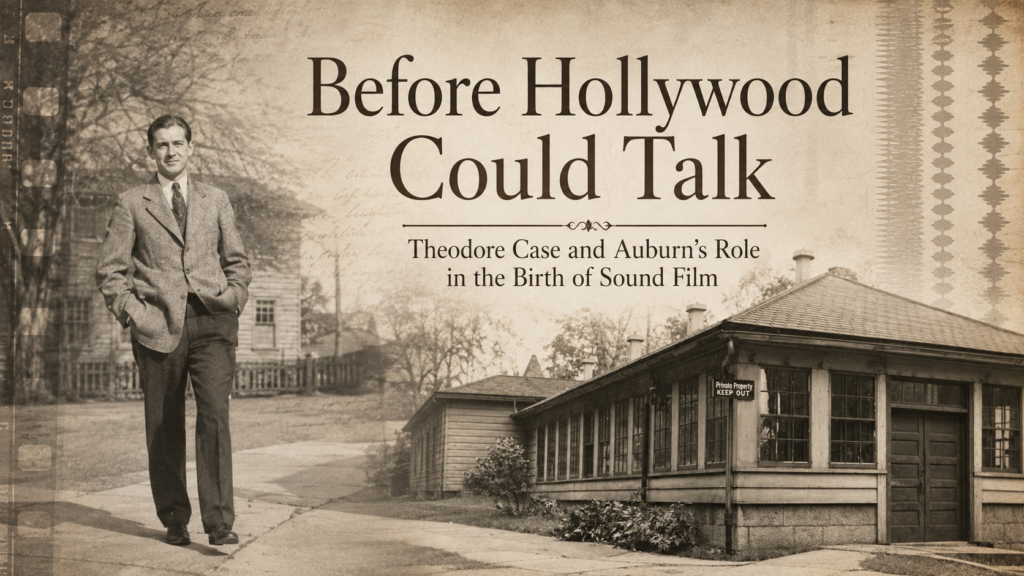
Before Hollywood Could Talk: Theodore Case and the Finger Lakes Birthplace of Sound Film
Long before synchronized dialogue became an expected part of going to the movies, some of the technology that would give film its voice was being developed far from Hollywood.
It was happening in Auburn, New York, inside a converted greenhouse behind a stately home on Genesee Street.
There, inventor Theodore Willard Case, working with a small team that included his gifted assistant Earl Sponable, helped develop a commercially successful method for recording sound directly onto motion-picture film. Their work would become part of the technological revolution that ended the silent-film era and transformed entertainment around the world.
For the Finger Lakes, it is a remarkable chapter of local history: one of the great changes in modern cinema can trace an important part of its story to a backyard laboratory in Auburn.
A Young Inventor Fascinated by Light and Sound
Born in 1888, Theodore “Ted” Case grew up in one of Auburn’s prominent families. His father, Willard Case, had a strong interest in electricity and science, and Theodore developed a similar fascination with experimentation.
After graduating from Yale University in 1912, Case returned to Auburn and continued investigating light, sound and photoelectric technology. He and his father established experimental laboratories in their homes on Genesee Street and at the family’s property on Owasco Lake.
In 1916, after the family acquired the Willard estate at 203 Genesee Street, a greenhouse on the property was converted into what became the Case Research Laboratory. Earl Sponable, a Cornell graduate, joined the operation and became one of Case’s most important collaborators.
The laboratory initially explored a variety of scientific ideas, including infrared technology. During World War I, Case developed an infrared signaling system for military use. But experiments involving light-sensitive materials would eventually lead the laboratory toward an entirely different challenge: putting sound onto film.
Making the Movies Speak
During the early 1920s, the motion-picture industry was still overwhelmingly silent. Audiences watched films accompanied by live pianists, organists or orchestras, while dialogue appeared on intertitle cards.
The challenge was not simply recording sound. The real breakthrough required finding a reliable way to keep recorded sound precisely synchronized with the moving picture.
Case’s laboratory worked on a method in which sound was converted into patterns of light and recorded photographically along the edge of the film itself. When projected, that optical soundtrack could be converted back into sound.
A crucial breakthrough came in 1922, when Case developed what became known as the AEO Light, an important component in making sound-on-film practical. Case and Sponable also worked for a time with inventor Lee de Forest on his Phonofilm system before disagreements over credit, financing and ownership ended the relationship.
By the middle of the decade, the small Auburn laboratory possessed technology with enormous commercial possibilities.
Hollywood began paying attention.
William Fox Comes Calling
In 1926, Case and Sponable demonstrated their sound-film system to motion-picture pioneer William Fox, head of the Fox Film Corporation.
Fox recognized its potential.
The resulting partnership created the Fox-Case Corporation, and the system became known as Movietone. Fox quickly began putting the technology to work, particularly in newsreels that allowed movie audiences not merely to see major events, but to hear them as well.
That was revolutionary.
Political speeches, public ceremonies, crowds, machinery and music could suddenly be experienced with synchronized sound inside movie theaters around the country.
The familiar Fox Movietone News name would eventually become one of the most recognizable brands of the newsreel era.
From an Auburn Laboratory to the Silver Screen
One of the most celebrated early productions associated with the Movietone system was Sunrise: A Song of Two Humans, released by Fox in 1927.
The acclaimed film was not a modern talking picture filled with spoken dialogue. Instead, it used synchronized music and sound effects recorded with the Movietone process—a significant demonstration of what sound could add to the emotional power of motion pictures.
Meanwhile, competing sound technologies were developing rapidly. Warner Bros. had introduced the Vitaphone system, and The Jazz Singer, released in 1927, became famous for its synchronized singing and spoken sequences.
The transition from silent movies to sound was not the achievement of one inventor or one company. It was a technological race involving competing systems and numerous engineers.
But the work performed by Case and Sponable in Auburn occupies an important place in that story. The Cayuga Museum today describes Case’s achievement as the development of the first commercially successful sound-on-film system.
The Laboratory Is Still There
The extraordinary part of the story is that the place where much of this work occurred still survives.
Behind the Cayuga Museum of History and Art at 203 Genesee Street stands the Case Research Laboratory, preserved as part of the museum complex.
Visitors can see the working spaces of the original darkroom, chemistry laboratory and recording studio, along with experimental equipment, archival material and early sound-film technology—including the laboratory’s first sound camera. The museum’s collection also preserves Case’s notebooks, correspondence, patents, technical drawings and several original test films.
It is a surprisingly modest setting for an invention with such enormous consequences.
There are no sprawling studio lots or Hollywood marquees.
Just a small laboratory in Auburn where scientists were experimenting with light.
And changing movies forever.
The Owasco Lake Connection
Case’s story also reaches south from Auburn along the shoreline of Owasco Lake.
The Case family owned a lakeside estate that became known as Casowasco, near Moravia. Before the Genesee Street laboratory was fully established, Theodore and his father conducted scientific experiments both in Auburn and at the family property on Owasco Lake.
The property later became Casowasco Camp & Retreat Center, continuing a completely different chapter in the site’s history.
Today, generations of visitors know Casowasco for summer camps, retreats, wooded hillsides and its sweeping view across Owasco Lake.
Yet the property also provides an unexpected connection between rural Finger Lakes life and the earliest development of modern media technology.
Before sound film became a worldwide industry, some of Theodore Case’s scientific curiosity was already being pursued along this quiet lakeshore.
A Finger Lakes Innovation That Changed the World
Theodore Case died in 1944, and his name never became as universally familiar as Thomas Edison, Walt Disney or the Hollywood studios that came to dominate American filmmaking.
But recognition of his work has grown.
His former home became the Cayuga Museum of History and Art, and the museum continues to preserve both the Case Research Laboratory and an extensive archive documenting the work performed there. Case’s longtime collaborator Earl Sponable went on to a distinguished career in the film industry, eventually serving as director of research for Twentieth Century Fox and contributing to later developments including CinemaScope.
Their story is a reminder that transformative ideas do not always begin in the places we expect.
One of the technologies that changed movies forever wasn’t born beneath the palm trees of Southern California.
It emerged from experiments with light, electricity and film inside a converted greenhouse in Auburn, New York.
The next time a soundtrack rises, an actor whispers a line, or the roar of a crowd fills a theater, there is a small piece of Finger Lakes history behind the experience.
Before Hollywood learned to talk, Auburn helped give film a voice.
Explore the Story
The Cayuga Museum of History and Art and Case Research Laboratory offer visitors an opportunity to see the surviving laboratory and learn more about Theodore Case, Earl Sponable and the development of sound film. The museum currently offers guided Case Research Laboratory tours as part of its programming.
For anyone interested in Finger Lakes history, science, filmmaking or inventions that changed everyday life, it is one of Auburn’s most fascinating—and perhaps most surprising—stories.