
Market Days: Where the Finger Lakes Comes Together
There is something about a farmers market that captures the character of the Finger Lakes better than almost anywhere else.
On a Saturday morning, tables overflow with tomatoes still warm from the field, baskets of peaches and apples fill the aisles, and the smell of fresh bread drifts past displays of handmade pottery, local honey, flowers, cheese, and preserves. Farmers talk with longtime customers. Visitors linger over coffee. Musicians play nearby while families wander from booth to booth.
These markets may begin with food, but they quickly become something more. They are gathering places—part shopping trip, part community tradition, and part introduction to the people who make the Finger Lakes what it is.
Where Local Really Means Local
The Finger Lakes has long been an agricultural region. Its rolling hills, fertile valleys, orchards, vineyards, dairy farms, and small family operations have shaped both the landscape and the communities scattered across it.
Farmers markets bring that agricultural heritage directly into town.
Instead of picking vegetables from a supermarket display, shoppers can often buy them from the person who planted, tended, and harvested them. A jar of jam may come from fruit grown just a few miles away. The baker selling a loaf of bread may be able to tell you exactly when it came from the oven that morning.
That personal connection is part of the appeal.
A conversation over a basket of tomatoes might turn into advice about the best variety for sauce. A cheesemaker may explain which local wine pairs best with a particular cheddar. A farmer might suggest a new way to prepare squash or tell you when the season’s first sweet corn will arrive.
Those small exchanges turn an ordinary purchase into a connection with the region.
The Windmill: A Finger Lakes Destination
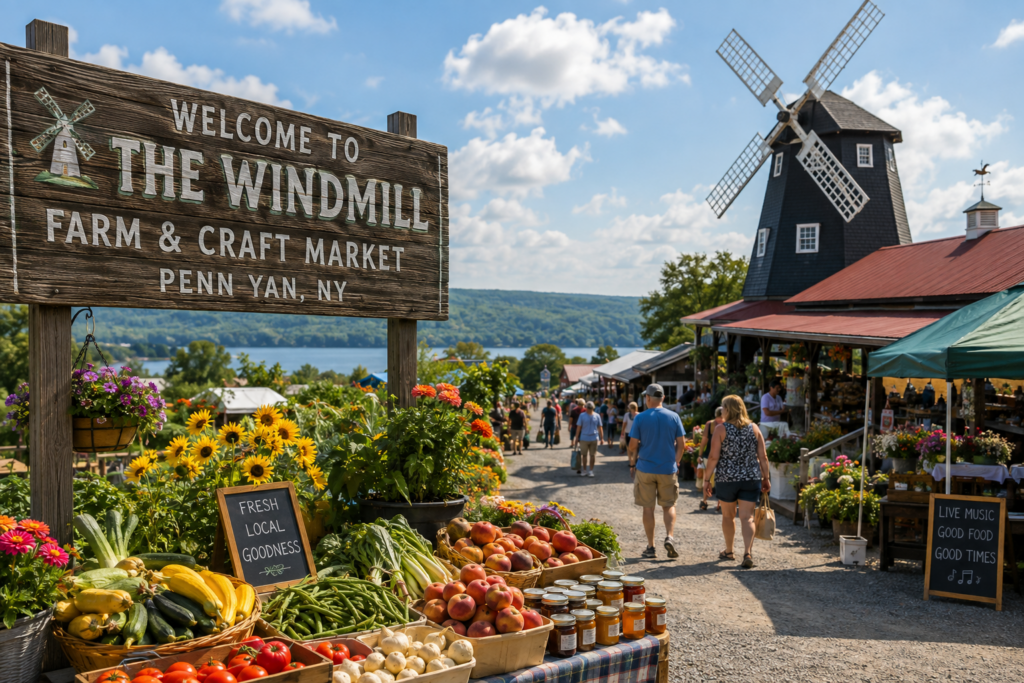
Among the region’s best-known market experiences is The Windmill Farm & Craft Market, located along Route 14A south of Penn Yan.
The Windmill is considerably more than a traditional farmers market. With more than 175 indoor and outdoor vendors spread across its grounds, it feels like a small village that comes to life each market day.
Fresh produce sits alongside baked goods, cheeses, jams, honey, flowers, handcrafted furniture, pottery, quilts, artwork, gifts, and home décor. Food vendors offer plenty of reasons to arrive hungry, while music and outdoor gathering spaces encourage visitors to stay awhile.
Amish and Mennonite traditions are also an important part of the market’s character, particularly among vendors offering baked goods, foods, woodworking, and handcrafted items.
The result is a place where agriculture, craftsmanship, food, and tourism intersect.
For many visitors, The Windmill is not simply somewhere to buy vegetables before heading home. It becomes the day’s destination.
Ithaca’s Market on the Water
At the southern end of Cayuga Lake, the Ithaca Farmers Market offers an entirely different atmosphere.
Its waterfront setting and covered pavilion have helped make it one of the area’s most recognizable markets. Here, farm stands mingle with prepared foods, baked goods, artwork, flowers, crafts, and international flavors reflecting Ithaca’s diverse community.
It is the kind of place where someone may arrive looking for lettuce and leave after eating lunch beside the water, listening to music, and discovering a local artist they had never encountered before.
The market’s setting reinforces something that distinguishes many Finger Lakes markets: the experience is as important as the shopping.
Canandaigua: Keeping the Focus on Producers
In Canandaigua, the farmers market tradition remains closely tied to the people who actually grow and make what they sell.
Seasonal vegetables, fruit, meats, baked goods, flowers, maple products, and other regional foods give shoppers an opportunity to follow the agricultural calendar through the year.
Early summer brings greens and strawberries. Later come sweet corn and tomatoes. Then apples, squash, pumpkins, and the deeper flavors of autumn begin appearing on tables.
Visiting regularly provides a reminder that eating locally once meant eating seasonally—and in the Finger Lakes, it still can.
Geneva: A Market in the Heart of the Community
Geneva’s market offers another variation on the tradition.
Set within a city closely connected to Seneca Lake and surrounding farm country, it brings growers and producers into the center of everyday community life. Fresh produce, flowers, baked goods, specialty foods, and local products give residents and visitors an opportunity to experience the agricultural region that begins almost immediately beyond the city’s streets.
Smaller markets such as Geneva’s can sometimes provide the most personal experiences. Vendors recognize returning customers, conversations stretch beyond the transaction, and shopping becomes part of the weekly rhythm of town life.
Corning: Local Flavor Meets Downtown Life
In Corning, the farmers market complements one of the Finger Lakes region’s most active downtown districts.
A morning spent browsing farm stands can easily become part of a larger day that includes restaurants, shops, galleries, museums, and the surrounding Gaffer District.
It illustrates how farmers markets increasingly serve as bridges between rural and downtown economies. The farmer from outside the city gains access to customers, while downtown businesses benefit from visitors drawn into the community.
Everyone becomes part of the same local economy.
More Than a Place to Buy Groceries
The renewed popularity of farmers markets reflects something larger than an interest in fresh vegetables.
People increasingly want to know where things come from.
They want bread baked nearby. Honey collected from local hives. Pottery made by regional artists. Apples grown on hills they may have driven past. Cheese produced from milk that originated on a Finger Lakes farm.
Markets make those connections visible.
They also provide an important sales outlet for small farms and independent producers who may not have access to conventional retail shelves. Every bunch of carrots, loaf of bread, handmade bowl, or jar of preserves represents a small business—and often a family whose livelihood remains closely tied to the region.
Make a Morning of It
The best way to visit a Finger Lakes farmers market is without rushing.
Arrive early if you are looking for something specific; popular baked goods and seasonal produce can disappear quickly. Bring reusable bags or a market basket, and leave some room for purchases you weren’t planning to make.
Most importantly, talk to the vendors.
Ask where something was grown. Ask what’s especially good that week. Ask how they prepare it themselves.
Those conversations often become the most memorable part of the visit.
And don’t assume farmers markets are only about vegetables. Depending on the market, you may find meats, cheeses, breads, pastries, maple syrup, honey, flowers, plants, prepared foods, coffee, artwork, woodworking, textiles, pottery, jewelry, and countless other locally produced goods.
The Finger Lakes, One Market at a Time
There are many ways to experience the Finger Lakes.
You can follow a wine trail, hike to a waterfall, spend an afternoon beside one of the lakes, or explore the region’s villages and historic downtowns.
But a farmers market offers something different.
Within a few aisles, you encounter the farms, kitchens, workshops, traditions, and personalities of the region all at once.
You see what is growing in the fields right now. You taste what is coming from local ovens. You discover what artists and craftspeople are making in their studios and workshops. And you meet the people behind it all.
Perhaps that is why farmers markets remain such enduring gathering places across the Finger Lakes.
They aren’t simply places where things are sold.
They are places where the region introduces itself—one peach, pie, flower, loaf of bread, and handmade piece of pottery at a time.