
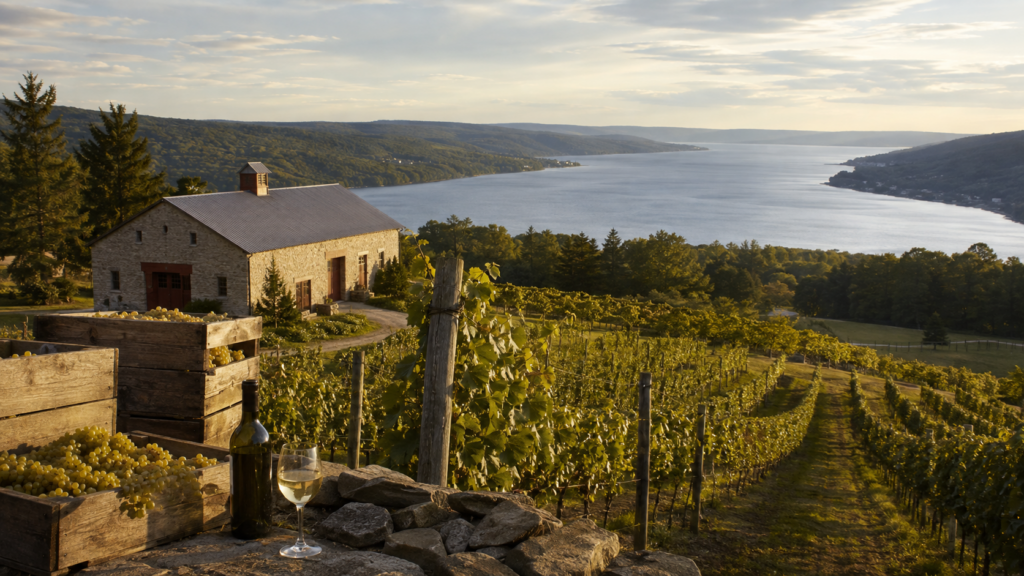
Dr. Konstantin Frank and the Revolution That Changed Finger Lakes Wine
How one immigrant viticulturist challenged conventional wisdom, planted European grapes above Keuka Lake, and helped transform the Finger Lakes into one of America’s most respected cool-climate wine regions.
There are moments in a region’s history when one person changes not simply an industry, but the way a place sees itself.
For the Finger Lakes, one of those moments came on a hillside overlooking Keuka Lake, where a Ukrainian-born viticulturist named Dr. Konstantin Frank looked at the climate, the soil and the long-established assumptions of New York winemakers—and concluded that almost everyone was wrong.
The prevailing belief was straightforward: the winters of Upstate New York were simply too severe for the great European wine grapes.
Frank believed otherwise.
And what happened next helped remake the Finger Lakes.
Before the Revolution
Wine and grapes were part of Finger Lakes agriculture long before Konstantin Frank arrived.
Commercial grape growing expanded around Keuka Lake during the 19th century, particularly near Hammondsport, where the combination of steep hillsides, lake influence and established transportation routes encouraged a thriving grape industry.
But growers faced a fundamental problem.
The celebrated wine grapes of Europe—Vitis vinifera varieties such as Riesling, Chardonnay and Pinot Noir—had historically struggled in eastern North America. Instead, New York vineyards relied heavily on native American grapes and, later, French-American hybrids.
These vines could survive the climate and local pests, but many winemakers believed they could not consistently produce the kind of fine table wines associated with the great regions of Europe.
Prohibition dealt another enormous blow to American wine culture. When the industry began rebuilding, much of New York wine production remained centered on sweeter styles and hardy grape varieties.
By the middle of the 20th century, the Finger Lakes certainly had a wine industry.
What it did not yet have was the international reputation it enjoys today.
A Viticulturist From Ukraine
Konstantin Frank was born in 1899 near Odessa, in what is now Ukraine. He earned a doctorate in viticulture from the Polytechnic Institute of Odessa in 1930, with research focused on growing European grape varieties in cold climates.
His experience was particularly important because he had already worked with grapes under severe winter conditions in Eastern Europe.
Frank and his family eventually left the Soviet Union and immigrated to the United States in 1951. He was 52 years old, spoke little English and had to begin again professionally in a new country.
He eventually found his way to the Finger Lakes, joining the agricultural research community around Cornell University’s Geneva Experiment Station.
What Frank saw in New York puzzled him.
Growers blamed the cold for repeated failures with European vines.
Frank believed they were diagnosing the wrong problem.
The Question of the Roots
Frank’s argument was rooted—quite literally—in viticultural science.
European wine grapes could tolerate the Finger Lakes climate better than many people believed, he maintained. One of the more serious obstacles was phylloxera, the tiny vineyard pest that attacks grapevine roots.
The solution had already transformed viticulture elsewhere: graft the desirable European grape variety onto resistant American rootstock.
Frank argued that with appropriate rootstocks, site selection and vineyard practices, European grapes could succeed in the Finger Lakes.
At first, the idea attracted considerable skepticism.
Cornell recounts how Frank eventually found an important ally in Charles Fournier, an experienced French winemaker associated with Gold Seal Vineyards near Hammondsport. Frank joined Gold Seal in 1954 as a consultant and director of vineyard research, where he was able to demonstrate his theories in practice.
The vines survived.
More importantly, they produced promising fruit.
Keuka Lake Becomes the Laboratory
In 1958, Frank purchased property on the western side of Keuka Lake near Hammondsport.
The land possessed characteristics that might seem undesirable for ordinary farming: slopes and relatively poor soils.
For grapes, those characteristics could be advantages.
The lake itself mattered as well.
Large Finger Lakes absorb and release heat more slowly than the surrounding land, moderating temperatures along nearby slopes. Hillside vineyards also allow cold air to drain downward rather than settling around the vines.
Frank began planting European varieties there, continuing the experiment that was rapidly becoming a revolution.
Riesling would become especially important.
So would Chardonnay, Pinot Noir and an expanding collection of European varieties that many once considered impractical for New York.
Vinifera Wine Cellars
In 1962, after leaving Gold Seal, Frank founded his own winery: Vinifera Wine Cellars, today known as Dr. Konstantin Frank Winery.
Its first vintage included Riesling made from botrytized grapes.
The winery quickly became known for its Rieslings, but Frank’s larger accomplishment went beyond producing successful bottles of wine.
He had demonstrated something.
The Finger Lakes could grow Vitis vinifera commercially.
Cornell’s archives record that during the 23 years Frank owned the winery, he planted more than 60 European grape varieties, an extraordinary exercise in experimentation designed to determine what the region could accomplish.
The implications spread far beyond one vineyard.
The Vinifera Revolution
Other growers began paying attention.
If Riesling could thrive along Keuka Lake, perhaps it could thrive along Seneca.
If Chardonnay could survive a Finger Lakes winter, perhaps carefully chosen sites around Cayuga Lake could support it as well.
Frank’s success changed the assumptions behind New York viticulture.
Vineyards increasingly experimented with vinifera varieties. Winemakers improved their techniques. Universities and agricultural researchers expanded their work. A new generation of wineries emerged.
Gradually, the Finger Lakes began moving away from an identity based primarily on hardy native grapes and sweet wines toward something different:
a serious cool-climate wine region.
That transition took decades and involved hundreds of growers, winemakers, researchers and entrepreneurs.
But Frank’s experiments provided one of its critical foundations.
Why Riesling Found a Home Here
Of all the varieties associated with the Finger Lakes today, none is more closely identified with the region than Riesling.
The grape thrives in cool climates, where a long growing season can preserve acidity while allowing complex flavors to develop.
Finger Lakes geography offers exactly the kind of conditions Riesling favors.
Deep lakes moderate nearby temperatures. Sloping vineyards improve air drainage. Varied glacial soils create striking differences from one vineyard to another.
The resulting wines can range from bone-dry to richly sweet, while often retaining the bright acidity that has become a Finger Lakes hallmark.
Today, when wine writers discuss American Riesling, the Finger Lakes is routinely part of the conversation.
That would have been difficult to imagine when Frank first began arguing that European grapes belonged here.
A Family Legacy
Konstantin Frank died in 1985, but his work continued through succeeding generations of the Frank family.
His son, Willy Frank, expanded the family’s ambitions into traditional-method sparkling wine.
After purchasing and restoring a historic stone property later known as Chateau Frank, Willy developed sparkling wines using classic vinifera grapes associated with Champagne. In 1985, the family released what the winery describes as the Finger Lakes’ first traditional-method sparkling wine produced from vinifera grapes.
The winery has now continued through four generations.
That continuity is fitting because experimentation—the willingness to ask whether the Finger Lakes can do something previously thought impossible—remains part of the region’s wine culture.
More Than One Man’s Story
It would be too simple to say that Konstantin Frank single-handedly created Finger Lakes wine.
He didn’t.
The region’s grape-growing history predates him by generations. Researchers, growers, vineyard workers and other pioneering wineries all contributed to the industry’s development.
Cornell University’s agricultural research and extension programs have also played a substantial role in improving everything from grape varieties and disease management to vineyard practices and winemaking.
But Frank changed what growers believed was possible.
That may be his greatest contribution.
He replaced one question—
Can European grapes survive here?
—with another—
How good can Finger Lakes wine become?
A Landscape Transformed
Drive around the Finger Lakes today and the answer is visible almost everywhere.
Vineyard rows climb hills above Seneca Lake.
Tasting rooms overlook Cayuga.
Wineries line the slopes around Keuka.
Riesling, Cabernet Franc, Chardonnay, Gewürztraminer, Pinot Noir and other varieties appear on bottles bearing the words Finger Lakes, New York.
Restaurants build wine lists around local producers. Visitors travel specifically to explore the region’s wine trails. Winemakers arrive from around the world to work harvests here.
What was once considered a difficult place to grow European grapes is now recognized as one of America’s distinctive cool-climate wine regions.
And on the southwestern hills above Keuka Lake, the winery bearing Dr. Konstantin Frank’s name still stands among the vineyards where that transformation began.
The Man Who Refused to Accept “Impossible”
There is something particularly Finger Lakes about the Konstantin Frank story.
It isn’t a story of instant success.
It is a story of patience.
Of understanding the land.
Of challenging assumptions.
And of believing that a landscape others considered limiting might actually contain an extraordinary opportunity.
More than six decades after Vinifera Wine Cellars opened, every glass of Finger Lakes Riesling carries a little of that history.
The region’s modern wine industry has grown far beyond one man, one winery or one lake.
But when the story of Finger Lakes wine is told, there is still a hillside above Keuka Lake where an immigrant scientist planted vines and proved that the impossible wasn’t impossible after all.