
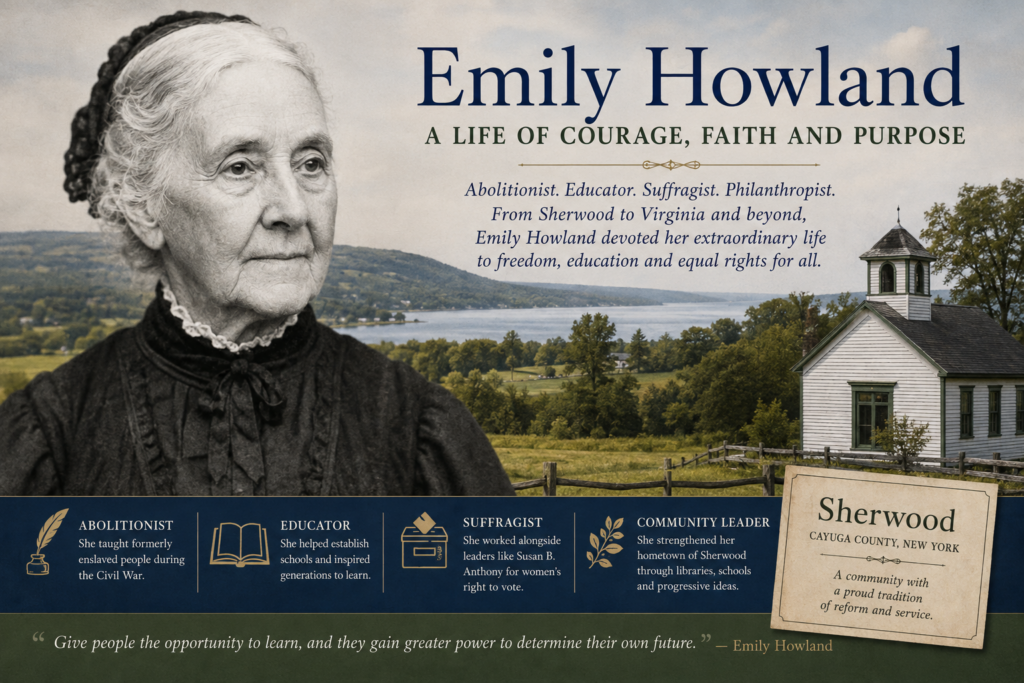
Emily Howland: The Finger Lakes Woman Who Refused to Accept the World as It Was
From a quiet corner of Cayuga County, Emily Howland spent nearly a century challenging some of the most deeply rooted inequalities in American life.
In the rolling countryside of southern Cayuga County, not far from Owasco Lake, stands the small community of Sherwood. It is the kind of place that can easily be passed without realizing how much history unfolded there.
Yet Sherwood was once home to one of the Finger Lakes region’s most remarkable reformers.
Emily Howland was an abolitionist, educator, suffragist, philanthropist and advocate for equal opportunity whose life stretched from the era of slavery through the early years of the Great Depression.
Born in 1827, Howland lived to be 101 years old. During those extraordinary decades, she did far more than witness history.
She helped change it.
Growing Up in a Community of Reform
Emily Howland was born on November 20, 1827, into a Quaker family in Sherwood, New York. The Howland family was prosperous, but their home was also shaped by the Quaker traditions of equality, education and social responsibility.
Those beliefs placed the family within a broader network of reformers in central New York.
During the nineteenth century, the Finger Lakes became an important crossroads for some of America’s great social movements. Abolitionists challenged slavery. Women’s-rights advocates questioned laws and customs that denied women political and economic power. Religious reformers experimented with new ideas about equality and society.
The Seneca Falls Convention of 1848 took place only a few dozen miles from Howland’s home.
For Emily Howland, these were not distant political debates.
They became the work of her life.
A Teacher During the Civil War
Howland’s opposition to slavery eventually took her far beyond Sherwood.
During the Civil War, she traveled to the Washington, D.C., area and worked among formerly enslaved people who had escaped or been freed as Union forces advanced through the South.
Education became one of her greatest convictions.
Howland understood something that would guide her work for decades: freedom meant far more than the absence of slavery. Without access to education, property, employment and political participation, genuine equality would remain out of reach.
She taught formerly enslaved people and became deeply involved in efforts to establish educational opportunities for African Americans.
Her commitment did not end when the war did.
Building a School in Virginia
After the Civil War, Howland continued supporting education for African Americans in the South.
One of her most enduring contributions came in Virginia, where she helped establish a school for Black children in the community of Heathsville.
What began as a relatively modest educational effort grew into a lasting institution.
Howland invested not only money but time, organization and personal commitment into the school and the surrounding community. She believed education could provide families with opportunities that generations of slavery had denied them.
That work placed her among the many teachers and reformers who participated in the enormous—and often dangerous—effort to build schools for formerly enslaved Americans during Reconstruction.
The Fight for Women’s Rights
Howland brought the same determination to another cause: women’s equality.
For much of her life, American women could not vote.
They faced significant restrictions involving property, education, employment and participation in public life. Howland joined the growing movement seeking to change those conditions.
Her activism connected her with prominent leaders of the women’s suffrage movement, including Susan B. Anthony and other reformers who traveled through central and western New York.
Howland attended conventions, supported suffrage organizations and used her resources to advance women’s political equality.
She lived long enough to see a victory that had seemed almost unimaginable when she was young.
In 1920, the 19th Amendment to the United States Constitution was ratified, prohibiting the denial of voting rights on the basis of sex.
Emily Howland was 92 years old.
After spending decades advocating for women’s suffrage, she could finally cast a ballot in a presidential election.
Education at Home
Howland’s belief in education was not limited to distant communities.
She also worked to improve educational opportunities in her own hometown.
In Sherwood, she helped establish and support a school that became known for progressive educational ideas. Her philosophy was unusually broad for the period. Education, she believed, should prepare students not simply to earn a living but to participate thoughtfully in society.
Her commitment to learning also extended to libraries and community institutions.
At a time when higher education remained inaccessible to many women and African Americans, Howland treated knowledge as something that should be shared rather than guarded.
That philosophy may be one of the most important threads connecting the many chapters of her life.
Whether teaching freed people in Virginia, supporting students in Cayuga County or advocating for women’s rights, she consistently returned to the same principle:
Give people the opportunity to learn, and they gain greater power to determine their own future.
A Remarkable Recognition
Late in her life, Howland received an extraordinary honor.
In 1926, the State University of New York at Albany—then known as the New York State College for Teachers—awarded her an honorary Doctor of Letters degree.
She was 99 years old.
The recognition reflected decades of work in education and social reform.
Two years later, on June 29, 1929, Emily Howland died at the age of 101.
She had been born when John Quincy Adams was still living. She witnessed the Civil War, Reconstruction, industrialization, the rise of the automobile, World War I and the achievement of women’s suffrage.
Few lives span so much American history.
Fewer still influence so much of it.
The Story Still Lives in Sherwood
Today, Emily Howland’s story remains closely connected to the landscape of southern Cayuga County.
Sherwood may be small, but its surviving historic buildings and institutions preserve the memory of a community that once participated in national movements for abolition, education and women’s rights.
That is part of what makes Howland’s story so compelling.
History did not happen only in Washington, Boston or New York City.
Sometimes it happened along the rural roads of the Finger Lakes.
It happened in farmhouses where abolitionists gathered.
It happened in small schools where someone decided that another child deserved an education.
It happened in community halls where women questioned why they could not vote.
And it happened because people such as Emily Howland refused to accept inequality simply because it had existed for generations.
A Finger Lakes Legacy
The Finger Lakes are often celebrated for their waterfalls, vineyards, lakes and villages. But another landscape exists beneath that familiar scenery—a landscape of ideas.
Frederick Douglass lived and worked in nearby Rochester. Harriet Tubman made Auburn her home. The first women’s-rights convention at Seneca Falls helped launch a national movement. Throughout central New York, abolitionists, Quakers, suffragists and educators formed networks that challenged the social order of their time.
Emily Howland belongs firmly within that history.
Yet perhaps the most remarkable thing about her life is not that she became famous.
It is that fame never seemed to be the point.
She taught.
She organized.
She gave.
She built schools.
She supported causes.
And she continued doing so decade after decade.
More than a century later, the little community of Sherwood still reminds us that enormous change can begin in remarkably small places.
Emily Howland proved it.