From Corning to the Kitchen: How Pyrex Changed the Way America Cooks
Born from heat-resistant glass developed in Corning, New York, Pyrex became one of America’s most familiar household names—and another example of how innovation from the Finger Lakes region reached homes around the world.
There is a good chance that somewhere in an American kitchen—perhaps tucked into the back of a cupboard or sitting on a pantry shelf—is a piece of Pyrex.
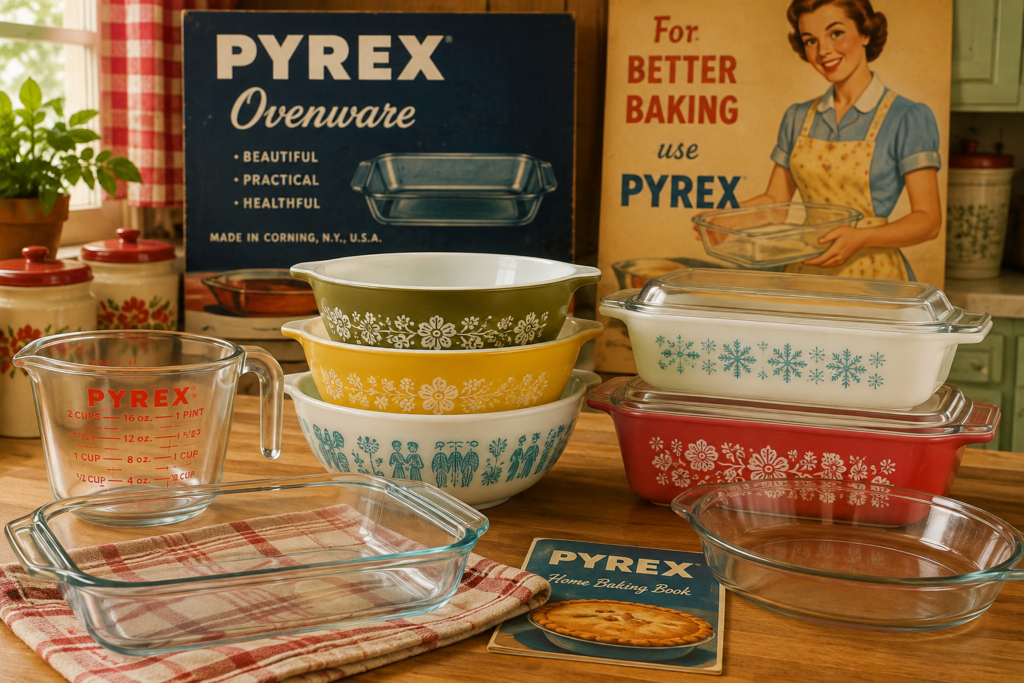
It might be a clear glass measuring cup with familiar red markings. It could be a casserole dish that has survived decades of family dinners. Or perhaps it is one of the colorful patterned bowls now sought by collectors.
Pyrex has become so commonplace that it is easy to forget what an extraordinary innovation it once represented.
And its story begins in Corning, New York.
A New Kind of Glass
At the beginning of the 20th century, glass presented a practical problem. Ordinary glass could crack or shatter when subjected to sudden changes in temperature.
For scientists and engineers at Corning Glass Works, the challenge was to develop glass that could withstand much greater thermal stress.
The company developed a heat-resistant borosilicate glass known as Nonex, originally intended largely for industrial applications, including railroad signal lanterns and battery jars. The glass was designed to tolerate dramatic temperature changes better than conventional glass.
But someone soon recognized that the same technology might have a place far beyond railroads and laboratories.
It might belong in the kitchen.
The Pie Plate That Helped Start a Revolution
The story traditionally associated with Pyrex involves Corning physicist Jesse Littleton and his wife, Bessie.
According to Corning’s historical accounts, Littleton brought home a piece of the company’s heat-resistant glass and encouraged his wife to experiment with it in the kitchen. Bessie used a sawed-off battery jar to bake a cake.
The experiment demonstrated something important: heat-resistant glass could be useful for cooking.
Unlike metal cookware, transparent glass allowed a cook to see what was happening inside the dish. It did not absorb food odors or flavors, and it could move from kitchen preparation to the dining table.
Corning saw an opportunity.
In 1915, the company introduced a line of heat-resistant glass cookware under a new name:
Pyrex.
Among its earliest products were pie plates, casserole dishes and other baking vessels.
A material developed to solve industrial problems had found an entirely new purpose.
An American Kitchen Staple
Pyrex arrived at a time when the American kitchen was changing rapidly.
Gas and electric ranges were becoming increasingly common. Prepared foods, standardized recipes and modern kitchen appliances were changing how families cooked. Manufacturers were beginning to market household products around convenience, cleanliness and efficiency.
Pyrex fit perfectly into that transformation.
Glass cookware offered something metal pans could not: visibility.
A cook could watch a pie crust brown through the bottom of the plate or see food cooking along the sides of a casserole.
Over the following decades, Pyrex expanded into an enormous range of kitchen products, including baking dishes, mixing bowls, measuring cups and storage containers.
For millions of families, the name eventually became almost synonymous with glass cookware itself.
When Pyrex Became Colorful
For many collectors, however, the most memorable chapter came later.
Beginning in the mid-20th century, Pyrex increasingly moved beyond clear glass cookware and into colorful kitchenware decorated with distinctive patterns.
Mixing bowls and casserole dishes appeared in bright colors and designs that reflected changing American tastes.
Patterns such as Butterprint, Gooseberry, Snowflake and Friendship became recognizable fixtures of postwar kitchens.
They were practical objects, but they were also cheerful pieces of domestic design.
Today, those bowls and casserole dishes can evoke powerful memories: holiday meals at a grandmother’s house, Sunday dinners, church suppers or a mixing bowl sitting on a kitchen counter while someone prepared a family recipe.
That emotional connection has helped turn vintage Pyrex into a thriving collecting category.
More Than a Bowl
The enduring popularity of Pyrex reveals something interesting about everyday objects.
The things that become part of our lives are not always monuments, paintings or expensive antiques.
Sometimes they are pie plates.
A Pyrex bowl might be passed from a grandmother to a daughter and eventually to a grandchild. Scratches, faded patterns and signs of use can become part of the object’s history rather than flaws.
Collectors now search antique stores, flea markets, estate sales and thrift shops for particular patterns, colors and shapes. Some rare examples can command substantial prices, while others remain inexpensive reminders of mid-century American kitchens.
But for many people, the value isn’t really monetary.
It is the memory attached to the object.
Corning’s Glassmaking Legacy
Pyrex also belongs to a much larger story about Corning.
The city became one of America’s great centers of glassmaking and glass science. Generations of researchers there experimented with materials that could withstand heat, transmit light, resist chemicals and eventually serve applications far removed from the kitchen.
That tradition continues today through Corning Incorporated and through the collections and research of the Corning Museum of Glass.
The story of Pyrex is therefore about more than cookware.
It is a story about what can happen when scientific experimentation encounters an ordinary human need.
A Finger Lakes Innovation That Traveled the World
The Finger Lakes are often celebrated for vineyards, waterfalls, farms and small towns. But the region has also produced inventions and industries whose influence extends far beyond Upstate New York.
Pyrex is one of the clearest examples.
What began with experiments in heat-resistant glass at Corning Glass Works eventually found its way into kitchens across America and around the world.
More than a century after Pyrex cookware first appeared, many of those pieces are still being used.
Some are carefully displayed by collectors.
Others are considerably less glamorous—holding leftovers in the refrigerator or carrying a casserole to a family gathering.
And perhaps that is the most remarkable part of the Pyrex story.
An innovation born in a glassworks in Corning didn’t simply become famous.
It became ordinary.
It became part of everyday life.
And more than a century later, a little piece of Finger Lakes ingenuity can still be found sitting in kitchen cupboards around the world.
Shop the Story
Take a piece of the story home.
Shop the Story brings together products inspired by the people, places, traditions, history, food, and natural beauty featured in 11 Lakes Magazine. Each collection begins with a story and carries its inspiration into thoughtfully designed merchandise celebrating the Finger Lakes.
From regional history and iconic destinations to local flavors and lakeside life, these products offer another way to connect with the stories—and the region—we love.
Read the story. Discover the place. Take a little of the Finger Lakes home.