
Can New Technology Solve the Problems Finger Lakes Farmers Face?
From frost-fighting systems and field robots to smarter dairy management, a new generation of agricultural technology is promising to make farming more efficient and resilient. But for the Finger Lakes’ family farms, the real test will be whether those innovations are practical, affordable and built for the realities of working the land.
On a Finger Lakes farm, the future rarely arrives all at once.
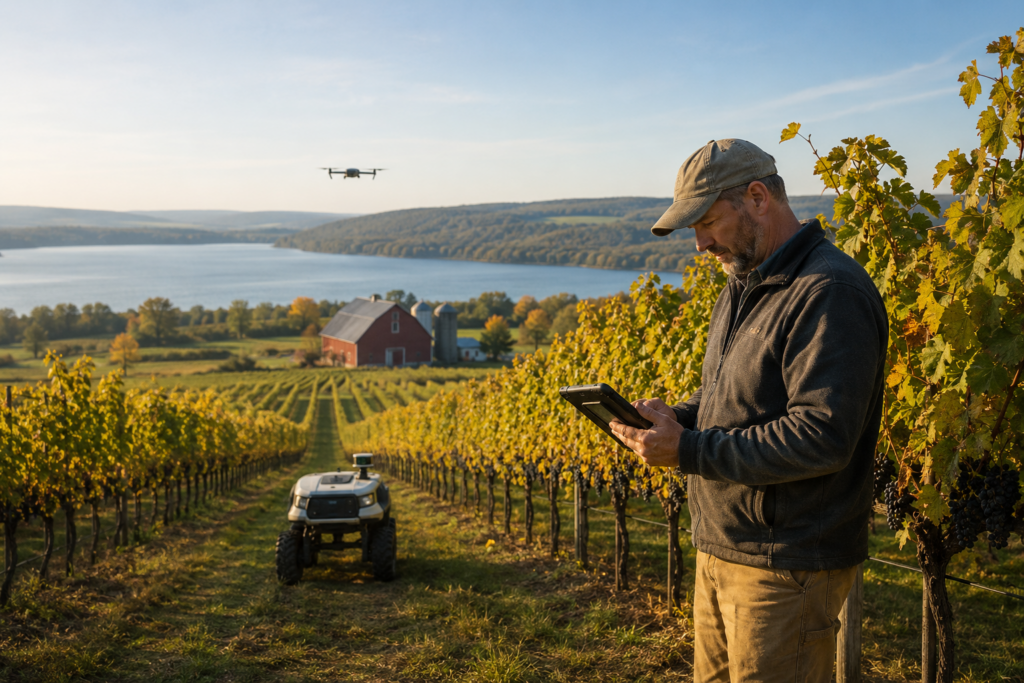
It may appear as a sensor fastened to a fence post, quietly measuring conditions in a vineyard. It may fly over an apple orchard in the form of a drone, mapping blossoms that once had to be evaluated row by row. In a dairy barn, it may be software tracking the health and productivity of individual cows. Somewhere else, it may be a machine learning to perform a repetitive job that a farmer can no longer find enough workers to do.
These technologies can sound futuristic, but the problems they are meant to address are immediate.
Farmers across the Finger Lakes contend with unpredictable weather, damaging spring frosts, rising costs, labor shortages, animal-health concerns and pressure to reduce environmental impacts. Technology companies say they can help. The more difficult question is whether their solutions will work—and whether the farms that need them can afford to use them.
A Regional Testing Ground
That question moved into sharper focus on August 24, when Empire State Development and Cornell University’s Center for Regional Economic Advancement announced the 20 finalists in the eighth annual Grow-NY food and agriculture competition.
The finalists will spend approximately 10 weeks refining their plans, meeting potential partners and exploring possible locations in the 22-county Grow-NY region. The competition concludes November 12 and 13 in Rochester, where seven companies will divide $3 million in investment awards.
The companies are not simply competing for prize money. Winners must commit to creating jobs, partnerships or business operations within the Grow-NY region, which includes the Finger Lakes, Central New York and the Southern Tier.
That requirement turns the competition into more than a showcase of interesting inventions. It creates the possibility that new agricultural technologies will be tested on local farms, shaped by local growers and perhaps eventually produced here.
Among the finalists are companies developing autonomous field-monitoring equipment, alternatives to chemical farm inputs, livestock-health technology and systems designed to reduce methane emissions from manure ponds. An Ithaca-based finalist, CryoBio, is developing a more affordable way to protect agricultural crops from frost—an especially relevant challenge for Finger Lakes vineyards and orchards. Empire State Development’s finalist announcement
Frost: A Few Degrees Can Change a Season
Few weather events demonstrate the vulnerability of farming more clearly than a late spring frost.
After grapevines and fruit trees begin to emerge from winter dormancy, a sudden drop in temperature can injure tender buds and young growth. Damage that occurs over a few cold hours can reduce the crop months before harvest.
Traditional frost-protection methods have limitations. Wind machines, heaters and irrigation systems can be expensive to purchase and operate. Their effectiveness depends on the farm, crop, terrain and type of weather event. Smaller growers may have fewer options and less capital available for equipment they might use only occasionally.
A reliable, affordable frost-control system could therefore have an outsized effect in the Finger Lakes. It could help protect not only a season’s grapes or apples, but also the businesses that depend on them—wineries, farm markets, processors, restaurants and tourism destinations.
Yet the word “affordable” matters as much as “effective.” A technology that works in a laboratory or demonstration vineyard still has to prove itself across rolling hills, irregular fields and the varying microclimates surrounding the lakes.
Farmers will want evidence: How many acres can it protect? How quickly can it be deployed? What does it cost to operate? Can a small vineyard use it without hiring specialized staff?
Those practical questions will determine whether an innovation becomes an everyday farm tool or remains an impressive experiment.
Robots in the Rows
Autonomous farming equipment offers another glimpse of agriculture’s possible future.
Budbreak Innovations, another Grow-NY finalist, is developing robots that move through fields while continuously gathering information about individual plants. The goal is to give growers more detailed data and help them identify problems sooner.
That kind of information could be valuable in the Finger Lakes, where vineyards and orchards often require close observation. A robot or drone might help identify uneven growth, disease pressure, water stress or developing pest problems before they become obvious across an entire field.
Cornell researchers are already exploring related technology in New York orchards. Drone-generated blossom maps, for example, can show growers which trees are flowering heavily and which areas need attention. That information can guide thinning and other decisions that affect the size, quality and consistency of the crop. Cornell CALS on innovations in orchard management
The appeal is easy to understand. Better information can help farmers use labor, water and crop treatments more precisely.
But autonomous equipment raises its own questions. Can it navigate steep vineyards, muddy fields and uneven terrain? Will it work reliably in rain, dust and changing light? Who repairs it when something fails during a critical point in the growing season?
Most importantly, does it save enough time or prevent enough loss to justify its price?
The Increasingly Digital Dairy Barn
Technology is also changing the region’s dairy farms.
Modern dairy operations can generate enormous amounts of information: milk production, feed consumption, body weight, breeding history, health treatments and movement patterns. When properly organized, those details can help a farmer identify illness earlier, improve feeding decisions and understand the economics of individual animals.
At Cornell’s farm-of-the-future initiative, researchers are developing and testing a system called MyCow$. The program combines production and management information to estimate the real-time cash flow of individual cows and groups within a herd.
The purpose is not to reduce an animal to a spreadsheet. It is to give farmers clearer information when making decisions about health, nutrition, breeding and herd management. Cornell’s CAST for the Farm of the Future
Similar technologies could be especially important as dairy farms operate on narrow margins. A small improvement in animal health, feed efficiency or milk production can become significant when repeated across a herd.
Still, more data does not automatically produce better decisions. Software must be accurate, understandable and compatible with the systems farmers already use. It also requires reliable internet access—something that cannot always be assumed in rural areas.
Can Technology Replace Farm Labor?
Labor shortages are often presented as a reason to automate, but the relationship between technology and farmworkers is more complicated than simply replacing people with machines.
A robot may take over repetitive monitoring, weeding or lifting. Automated systems can reduce physically demanding work and allow a smaller crew to cover more ground. Sensors can watch livestock or environmental conditions overnight without requiring someone to remain in the barn.
At the same time, advanced equipment creates demand for different skills. Farms may need workers who can interpret data, maintain electronics or troubleshoot software. Technology can reduce one labor need while creating another.
For many family farms, the best innovations may not be those that remove people from agriculture. They may be the ones that help farmers and employees use their limited time more effectively.
The Affordability Test
The promise of agricultural technology is real, but so is the risk of creating a wider divide between farms that can afford innovation and those that cannot.
Large operations may be able to purchase equipment, hire technical staff and absorb the cost of testing a new system. A smaller farm may not have that flexibility, even if the technology addresses an urgent need.
That makes the business model nearly as important as the invention.
Could equipment be rented during critical parts of the season? Could neighboring farms own machinery cooperatively? Could wineries, growers’ associations or local development organizations help establish shared services? Could grants or demonstration programs help farms test systems before committing to a major purchase?
The Finger Lakes has a history of agricultural cooperation, from extension programs and research partnerships to producer associations and shared processing resources. That culture may prove essential if new technology is to reach beyond the largest farms.
Tools, Not Miracles
Technology alone will not solve every problem facing Finger Lakes agriculture.
It cannot guarantee profitable commodity prices, create dependable weather or eliminate the uncertainty inherent in farming. It cannot replace the experience of a grower who understands how cold air settles in a particular vineyard or a dairy farmer who recognizes a subtle change in an animal’s behavior.
What it can do is give those farmers better tools.
A frost-control system may protect a vulnerable crop. A robot may notice a problem sooner. A biological product may reduce dependence on costly chemical inputs. Better dairy software may reveal an expense or health concern that would otherwise remain hidden.
The most successful technology will not arrive with the message that farmers have been doing everything wrong. It will begin by listening to the people who already know the fields, vines, orchards and animals.
As the Grow-NY finalists spend the coming weeks visiting the region and developing partnerships, that may be the most important measure of their potential: not simply whether their inventions are impressive, but whether Finger Lakes farmers believe those inventions belong on their farms.
The future of agriculture here will not be decided by technology companies alone. It will be decided in barns, vineyards, orchards and farm kitchens—one practical decision at a time.