
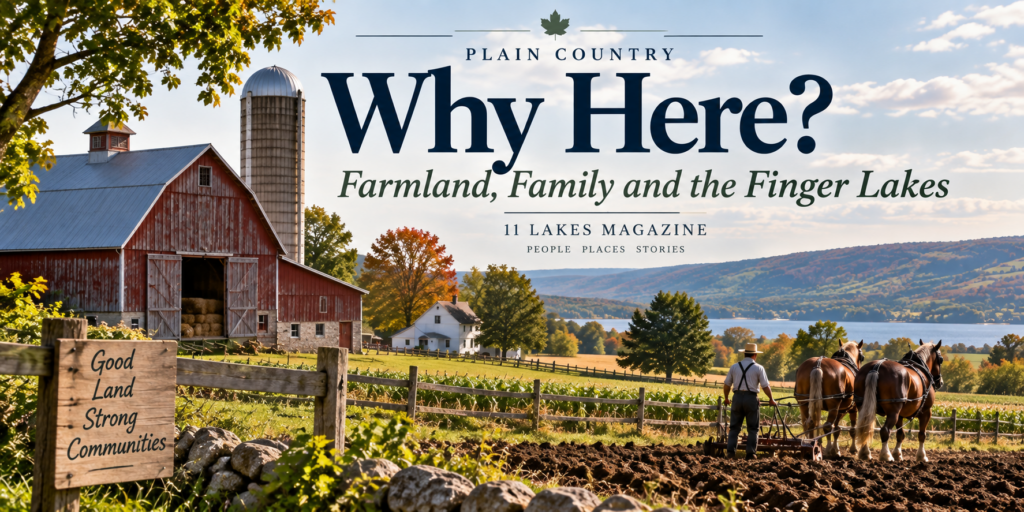
Why Here? Farmland, Family and the Finger Lakes
For Amish families looking for a place to build a future, the Finger Lakes offer something increasingly difficult to find elsewhere: rural communities where farmland, family and opportunity can still come together.
There is a question worth asking whenever a new Amish settlement begins to appear along the back roads of the Finger Lakes.
Why here?
Why would families leave established Amish communities—sometimes places where generations of relatives have lived—and begin again in rural New York?
Part of the answer can be found in something the Finger Lakes possesses in abundance.
Land.
Not simply beautiful land. Not lakefront property or vineyard-covered hillsides photographed for travel brochures.
Working land.
Pastures. Hayfields. Woodlots. Old dairy barns. Farmhouses. Acreage that can still support animals, crops and families willing to make their living from the soil.
For Amish families searching for a place where the next generation can establish farms and homes of their own, that matters enormously.
And it is one reason rural New York has become increasingly attractive.
When a Community Runs Out of Room
Amish families tend to be large.
That simple fact has profound consequences.
As children grow, marry and establish households of their own, a successful Amish community eventually needs more land.
Imagine a farming community containing dozens of families.
One generation owns the farms.
The next generation grows up.
Several sons may want to farm, but the original farm cannot simply be divided indefinitely.
Meanwhile, development pressures can push land prices upward.
A farm that might once have been affordable to a young family becomes financially impossible.
Eventually, families begin looking elsewhere.
That pattern has helped Amish settlement spread far beyond the areas most Americans traditionally associate with Amish life.
Pennsylvania remains famous for its Amish communities, as do Ohio and Indiana.
But Amish settlements today extend across many states—and New York has become an important part of that expansion.
The Attraction of Rural New York
The Finger Lakes and surrounding portions of Central and Western New York contain something increasingly scarce in parts of the Northeast: large areas of agricultural land away from major metropolitan development.
Not all of it is inexpensive.
Land near lakes, growing communities or desirable tourism destinations can command substantial prices.
But travel away from those areas and the picture changes.
Here, there are communities shaped by generations of dairy farming.
Some have experienced the same transformation occurring throughout rural America.
Small dairy farms disappeared.
Barns became empty.
Fields were rented to larger operations.
Farmhouses changed hands.
Young people found careers elsewhere.
In some places, the agricultural landscape remained even as the number of families actually farming it declined.
For an Amish family, such a property may represent something very different.
It can represent opportunity.
Seeing Potential in an Old Farm
Consider an aging dairy farm.
The barn needs repairs.
The fencing is tired.
The farmhouse hasn’t been modernized in years.
There may be no fashionable kitchen, no swimming pool and certainly no lake view.
To many buyers, those shortcomings reduce the property’s appeal.
To a family primarily interested in farming, the calculation can be entirely different.
Is there good soil?
Is there pasture?
Is there water?
Can livestock be kept there?
Is there enough acreage?
Are there other Amish families nearby?
Could another farm eventually be purchased for a son or daughter?
Suddenly the old farm looks much more promising.
And when families arrive, changes can happen quickly.
Fences are rebuilt.
Gardens appear.
Pastures hold animals again.
Outbuildings are repaired.
A property that seemed to be drifting away from agriculture becomes unmistakably a farm once more.
One Family Isn’t a Community
There is an important distinction between an Amish family moving into an area and an Amish community becoming established.
Amish life depends heavily upon community.
Church services, schools, transportation, work and mutual assistance all depend upon having other families reasonably close.
That means settlement often develops in clusters.
A few families arrive.
Relatives or acquaintances hear about available farmland.
Another property becomes available.
Another family moves.
Then another.
Eventually there may be enough households to establish a church district.
A school may be built.
Small businesses begin appearing.
A settlement that barely registered on the surrounding community’s radar can become a recognizable part of the countryside within a relatively short period.
Geography Still Matters
There is another reason rural Finger Lakes communities can work well for Amish settlement.
Distance matters differently when your primary transportation is a horse.
For most of us, twenty miles may mean a twenty-minute drive.
For someone traveling regularly by horse and buggy, those same twenty miles represent a considerably greater separation.
Amish communities therefore depend upon relatively compact networks.
Families need neighbors.
Schools need to be reachable.
Church gatherings rotate among homes.
Stores and services must be reasonably accessible.
This helps explain why Amish settlement can become particularly noticeable within certain pockets of the countryside rather than spreading evenly across an entire county.
Once a cluster forms, nearby farmland becomes especially valuable to other Amish families.
Community begins attracting community.
Farming Without Standing Still
The image many outsiders have of Amish agriculture is a farmer walking behind a team of horses.
That image isn’t necessarily wrong.
But it is incomplete.
Amish farmers operate in the same agricultural world as everyone else.
Feed costs rise.
Milk prices fluctuate.
Weather affects crops.
Equipment breaks.
Land prices change.
Markets evolve.
The challenge is finding ways to remain economically viable while operating within the technological and religious boundaries established by their community.
That has encouraged diversification.
Some families continue dairy farming.
Others raise livestock or grow vegetables.
Some operate greenhouses.
Others produce maple syrup or sell baked goods.
Still others move partially or entirely away from farming and into woodworking, construction, sawmills or other trades.
The result is an Amish economy that can be much more varied than it appears from the road.
The Roadside Stand
Perhaps nowhere is the connection between Amish families and their non-Amish neighbors more visible than at a roadside stand.
A simple sign appears:
EGGS
SWEET CORN
TOMATOES
BAKED GOODS
MAPLE SYRUP
There may be no elaborate storefront.
Sometimes there is only a small building, table or wagon.
Customers pull over.
Money changes hands.
Conversation follows.
And something interesting happens.
Two communities that live very differently meet over something as ordinary as a dozen eggs or a basket of tomatoes.
Those transactions may seem insignificant, but multiplied across a region they become part of the rural economy.
Amish families purchase goods and services from non-Amish businesses as well.
Hardware.
Building materials.
Veterinary services.
Agricultural supplies.
Transportation.
Land.
The relationship runs in both directions.
What Happens to the Land?
There is a larger Finger Lakes story here.
For decades, rural communities have wrestled with a difficult question:
What happens when the family farm disappears?
Sometimes another farmer purchases the acreage.
Sometimes land is rented.
Sometimes it returns gradually to woodland.
Sometimes development takes over.
And sometimes an Amish family arrives.
That does not mean Amish migration can—or should—be viewed as the solution to the economic challenges facing agriculture.
Amish farms face challenges of their own.
But their arrival can have an unmistakable effect on the landscape.
Agricultural land remains agricultural.
Old barns remain useful.
Pastures remain pastures.
Farmhouses remain connected to farms.
In a region where preserving open space and agricultural character is frequently discussed, that is significant.
Different Ideas of Prosperity
Perhaps the most interesting difference isn’t how Amish families farm.
It is how success is measured.
Modern American culture frequently associates prosperity with expansion.
A larger house.
A newer vehicle.
More technology.
More convenience.
More consumption.
Amish culture approaches many of those things differently.
That doesn’t mean Amish families reject business success. Many are highly capable farmers, craftspeople and entrepreneurs.
But economic activity exists within a larger social and religious framework.
The objective isn’t necessarily to build the largest possible business.
It may be to create something capable of supporting a family while allowing that family to remain within its community.
That difference can be difficult for outsiders to understand.
It also helps explain why an old Finger Lakes farm that seems economically unattractive to one buyer might represent exactly the opportunity another family has been searching for.
The Future Hidden in an Old Barn
Drive through the Finger Lakes and you’ll see countless old barns.
Some have been converted into wedding venues.
Some store boats or machinery.
Some lean noticeably toward the earth.
Others stand empty, reminders of farms that disappeared years ago.
But every so often, an old barn tells a different story.
Fresh lumber appears along one wall.
New fencing runs toward a pasture.
A team of horses stands nearby.
Children’s boots sit beside a farmhouse door.
Smoke rises from a chimney on a cold morning.
The farm is alive again.
That may be one of the most important things to understand about the Amish migration into rural New York.
To outsiders, these families can appear to represent the past.
But the families moving here aren’t coming to recreate a museum.
They are looking for a future.
And increasingly, they are finding a place to build that future among the farms, hills and back roads of the Finger Lakes.
Next in Plain Country
A Different Kind of Farm
In the next installment, we’ll step beyond the roadside view and explore Amish agriculture: horses and machinery, dairy farms and produce, woodworking and small businesses—and the surprising ways Amish farmers participate in the modern Finger Lakes economy.