
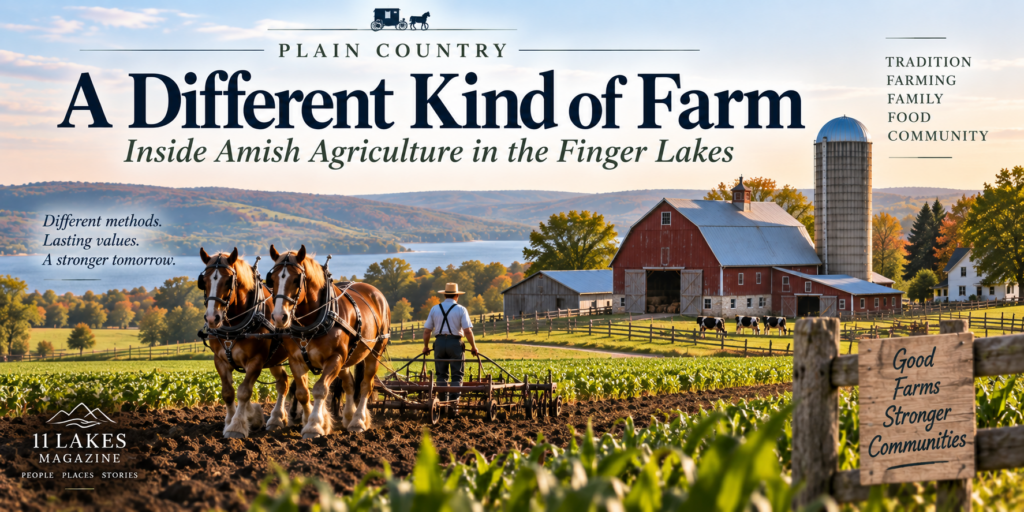
A Different Kind of Farm
Inside Amish Agriculture in the Finger Lakes
Horses may still work the fields, but Amish farming in the Finger Lakes is not agriculture frozen in time. It is a working economy adapting old traditions to modern realities.
On a warm Finger Lakes morning, the sound reaches you before the farm comes completely into view.
Not the deep rumble of a diesel tractor.
Hooves.
A team of draft horses moves steadily across a field, harnesses pulling tight as equipment follows behind.
From the road, the scene can look almost timeless.
It is easy to imagine that agriculture once looked exactly like this throughout the Finger Lakes.
In many ways, it did.
But look more closely at an Amish farm today and the story becomes considerably more complicated.
Because Amish agriculture isn’t an attempt to recreate the nineteenth century.
It is an attempt to make a farm work in the twenty-first century—while deciding very carefully which parts of the twenty-first century should be allowed through the gate.
The Horse at the Center of the Farm
For many Amish farmers, the draft horse remains fundamental.
Horses pull wagons.
They work fields.
They move equipment.
They provide transportation between farms.
And unlike the recreational horses seen elsewhere in the region, these animals are working members of the farm economy.
That requires an entirely different agricultural infrastructure.
A tractor needs fuel.
A horse needs pasture, hay, grain, water, veterinary care, harnesses and daily attention.
Land that might otherwise be devoted entirely to cash crops may also need to support the animals that provide the farm’s power.
And horses cannot simply be parked in a machinery shed after harvest.
They must be cared for every day.
The result is a farming system in which transportation, animal husbandry and field work remain closely connected.
But Don’t Assume There Is No Machinery
This is where the popular image of Amish farming begins to break down.
Amish farmers use machinery.
The question is often what kind, how it is powered and how it is used.
Practices vary considerably among Amish affiliations and individual church districts.
Some equipment may be horse-drawn while incorporating relatively modern agricultural technology.
Engines may sometimes be used for stationary work even where self-propelled tractors are restricted.
Pneumatic, hydraulic or other forms of power can be acceptable in some communities and restricted in others.
There is no universal Amish technology rulebook covering every farm in America.
Those decisions are influenced by the Ordnung—the community’s understood rules and expectations.
So when someone says, “The Amish don’t use technology,” the reality is much more interesting.
They do use technology.
They simply place boundaries around it.
A Different Question About Technology
Most of us approach a new technology by asking:
What can this do for me?
An Amish community may ask another question:
What will this do to us?
That difference helps explain many choices that otherwise seem contradictory.
A piece of machinery that improves farm productivity might be acceptable.
A technology believed to encourage excessive independence, weaken family relationships or connect the household too directly with the outside world may receive greater scrutiny.
The boundary isn’t necessarily between old and new.
It can be between technologies considered compatible with community life and those considered disruptive to it.
And those judgments can change.
Amish society is not static.
Communities adapt—usually deliberately and cautiously.
Dairy Country Meets Amish Agriculture
This makes the Finger Lakes an intriguing place for Amish farming.
Much of rural Central New York was shaped by dairy agriculture.
Drive the back roads and the evidence is everywhere.
Long barns.
Silos.
Pastures.
Milk houses.
Farmhouses sitting close to the road.
Some of those properties were designed for a style of agriculture that has become increasingly difficult for small conventional farms.
As dairy operations consolidated and equipment became larger and more expensive, many smaller farms disappeared.
But an older farm can sometimes fit an Amish operation remarkably well.
The barn still works.
The pasture still grows grass.
The fields still produce hay.
The farmhouse still shelters a family.
The agricultural infrastructure that seemed obsolete can suddenly become useful again.
Small Doesn’t Mean Simple
There can be a tendency to romanticize small farms.
That would be a mistake.
Small-scale agriculture is difficult.
Amish farmers confront many of the same pressures affecting their non-Amish neighbors.
Weather doesn’t distinguish between a horse-powered farm and a tractor-powered one.
Neither do crop diseases.
Feed costs still matter.
Animal health matters.
Land prices matter.
Customers matter.
A failed crop remains a failed crop.
And farming must ultimately produce enough income to support a household.
That economic reality has encouraged many Amish families to diversify.
Beyond the Dairy Barn
The Amish economy increasingly extends well beyond traditional dairy farming.
Across rural areas with Amish settlements, small enterprises can include vegetables, eggs, poultry, greenhouses, maple products, baked goods, lumber, furniture, construction and other trades.
Sometimes several activities operate from the same property.
A farm might raise livestock while also selling produce.
A woodworking shop might supplement agricultural income.
A greenhouse can create revenue before field crops are ready.
A roadside stand provides direct access to customers.
Diversification isn’t a fashionable business concept here.
It can be a practical way of keeping a family on the land.
The Farm Stand Economy
For many Finger Lakes residents, the roadside stand is the place where Amish agriculture becomes tangible.
You see the sign.
FRESH EGGS
SWEET CORN
TOMATOES
BAKED GOODS
You turn into the driveway.
Perhaps someone is there to help.
Perhaps payment operates on the honor system.
Either way, the distance between producer and customer has become remarkably small.
There is no national distribution center.
No elaborate packaging.
No complicated supply chain.
The tomatoes may have traveled a few hundred feet.
That direct relationship has obvious appeal in a region where interest in local food continues to grow.
But there is something else happening as well.
The farm stand becomes a small point of contact between two cultures.
A conversation begins over corn.
Someone asks when strawberries will be ready.
A customer returns the following week.
Familiarity develops.
Amish Businesses Without a Website
Then there are the enterprises you may hear about without ever seeing an advertisement.
“There’s a man who builds sheds.”
“Someone over that way makes furniture.”
“There’s a family selling maple syrup.”
“Ask around. Somebody will know.”
This can seem almost unimaginable in an economy dominated by online advertising and social media.
Yet reputation remains an extraordinarily effective form of marketing.
Good work creates another customer.
That customer tells someone else.
A business grows.
Some Amish businesses also interact indirectly with modern communications through non-Amish intermediaries or arrangements permitted by their particular community.
Again, practices vary.
The important point is that participation in the modern economy does not necessarily require adopting every feature of modern consumer culture.
The Neighbor Economy
The economic connections run much deeper than a farm stand.
An Amish farmer may purchase lumber from one local business and hardware from another.
Animals require veterinary services.
Equipment requires parts.
Property transactions involve banks, attorneys, sellers and real estate professionals.
Amish construction crews may work for non-Amish homeowners.
Non-Amish drivers may provide transportation for longer trips.
Produce may reach customers outside the immediate Amish community.
The idea of two completely separate economies—Amish and “English,” as non-Amish people are commonly called—is misleading.
They overlap constantly.
That means the growth of an Amish settlement can have economic consequences beyond the farms themselves.
Many Hands
There is another resource on an Amish farm that can be easy to overlook.
Labor.
Family and community remain central to the way work is organized.
Children gradually take on age-appropriate responsibilities.
Relatives help one another.
Neighbors assist when major projects require additional hands.
That cooperative culture becomes most visible during events such as barn raisings, but its importance extends into ordinary life.
When a family faces illness, fire or another hardship, the community can mobilize quickly.
It represents a form of social infrastructure that much of modern America has replaced with institutions, insurance and commercial services.
That doesn’t make one system inherently better than the other.
But it does make them profoundly different.
The Cost of Staying Small
There is an irony in the Amish approach to agriculture.
Remaining small requires constant adaptation.
The farmer using horses still operates in a marketplace affected by industrial agriculture.
The family selling vegetables competes with supermarkets.
The furniture maker competes with mass production.
The dairy farmer faces an industry transformed by scale and technology.
Tradition alone cannot pay the bills.
So Amish agriculture changes.
New businesses appear.
Different crops are tried.
Markets are found.
Equipment evolves within community rules.
Families move to places where land is more attainable.
That is part of what has brought Amish families to New York in the first place.
Looking Across the Fence
From the road, an Amish farm can appear to represent an earlier America.
The horses reinforce that impression.
So does the laundry on the line.
The absence of automobiles beside the house makes the contrast even stronger.
But perhaps we’re looking at it the wrong way.
This isn’t necessarily a farm trapped in the past.
It is a farm making a deliberate series of choices about the future.
Which technologies are necessary?
How large should a business become?
How much debt is acceptable?
How should children participate in family life?
How important is proximity to neighbors?
What is a farm ultimately supposed to provide?
Food?
Income?
A way of life?
A place for another generation?
Those questions aren’t uniquely Amish.
Farm families throughout the Finger Lakes have been asking versions of them for generations.
The answers are simply different.
A Different Kind of Modern
Late in the afternoon, the team turns toward the barn.
The field behind them shows the day’s work in long parallel rows.
Cars continue passing on the road.
Somewhere beyond the hills, tourists are finishing wine tastings. Boats cross the lakes. Phones buzz with messages. GPS systems calculate the fastest route home.
Here, leather harnesses creak.
Hooves strike the ground.
The horses keep walking.
It would be easy to call the scene old-fashioned.
But the farm survived another day.
The fields are still being worked.
A family is still making its living from the land.
And another Finger Lakes farm remains a farm.
Perhaps that isn’t a story about the past at all.
Perhaps it is simply a very different idea of progress.
Next in Plain Country
Neighbors, Not Tourists
The Amish may live differently from most Finger Lakes residents, but they don’t live in isolation. In our next installment, we’ll explore the everyday places where Amish and non-Amish lives intersect—from country stores and farm stands to local businesses, roads, auctions and the simple relationships that develop between neighbors.