
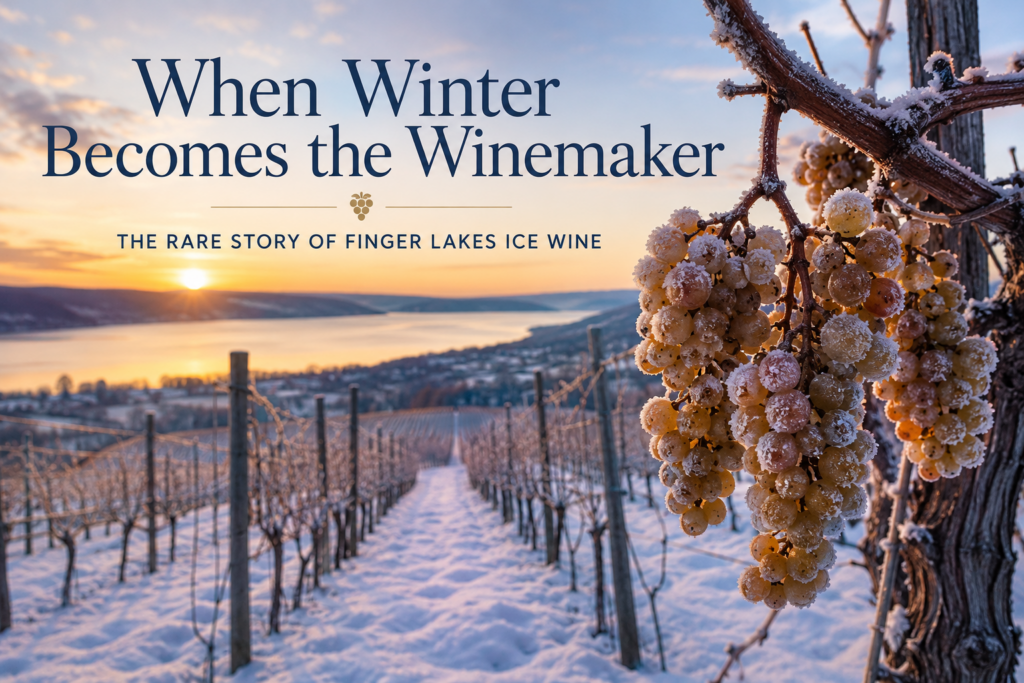
The Rare Story of Finger Lakes Ice Wine
There comes a point in a Finger Lakes winter when most of the vineyards appear to have gone quiet.
The tasting rooms may still welcome visitors, but outside, the brilliant greens of summer are gone. The hillsides have faded to brown and gray. Snow gathers between the rows, the lakes turn steel-blue beneath a low winter sky, and grapevines stand bare against the cold.
But look closely at a few vineyards and you may notice something unusual.
Clusters of grapes are still hanging from the vines.
They haven’t been forgotten.
They’re waiting for winter.
For a small number of Finger Lakes winemakers, the arrival of a deep freeze doesn’t mark the end of the harvest. It signals the beginning of one of winemaking’s most remarkable traditions: ice wine.
A Harvest That Waits for Winter
Most Finger Lakes grapes are harvested during the familiar rush of September and October. Trucks move through vineyards, picking crews work row after row, and wineries begin the long process of turning the year’s crop into Riesling, Chardonnay, Cabernet Franc and other wines.
Ice wine follows a very different calendar.
Selected grapes are deliberately left hanging long after the normal harvest. As autumn gives way to winter, the fruit slowly dehydrates and concentrates.
Then the vineyard waits.
True ice wine depends on something the winemaker cannot manufacture: a sufficiently hard natural freeze while the grapes are still on the vine.
When the right cold finally arrives, everything can happen quickly.
A vineyard that seemed dormant only hours earlier may suddenly come alive with workers heading into the rows, sometimes before sunrise, bundled against temperatures well below freezing.
The grapes must be harvested while they are frozen.
There is little room for delay.
Why Frozen Grapes Matter
The magic happens inside the grape.
When grapes freeze naturally on the vine, much of their water becomes ice. When those frozen grapes are pressed, the ice remains behind while a small quantity of intensely concentrated juice is extracted.
And “small” is an important word.
A quantity of grapes that would ordinarily produce a substantial amount of table wine may yield only a fraction as much ice wine.
The resulting juice can contain extraordinary concentrations of sugar, acidity and flavor.
Fermentation then turns that precious juice into a wine unlike almost anything else produced in the region.
A well-made ice wine can offer flavors reminiscent of honey, apricot, peach, baked apple, citrus, tropical fruit or candied orange peel, depending on the grape and vintage.
Yet sweetness alone isn’t what makes a great ice wine.
The best examples retain enough natural acidity to keep the wine bright and lively. That balance between intense sweetness and crisp acidity is precisely where the Finger Lakes can shine.
The Finger Lakes Advantage
The same geography that helped build the Finger Lakes wine industry also helps make ice wine possible.
The region’s deep lakes moderate temperatures in surrounding vineyards, extending the growing season and allowing grapes—particularly Riesling—to develop flavor while retaining acidity.
Then winter arrives.
Cold Canadian air can sweep across western and central New York, occasionally pushing vineyard temperatures low enough to freeze grapes solid.
That combination creates an intriguing paradox.
The lakes help grapes survive and ripen during the growing season.
Winter finishes the job.
It is one more example of how closely Finger Lakes wine is connected to the landscape surrounding it.
Riesling and the Cold
Riesling has become one of the signature grapes of the Finger Lakes for good reason.
It thrives in cool climates and naturally retains the acidity needed to balance sweetness. Those same characteristics make it particularly well suited to late-harvest and ice-style wines.
But leaving Riesling on the vine into winter is hardly a guaranteed path to a special bottle.
It is a gamble.
The Vineyard’s Waiting Game
Imagine leaving a valuable crop outside for weeks—or even months—after the normal harvest.
That is essentially what an ice-wine producer does.
Birds may discover the grapes.
Deer and other wildlife can take their share.
Windstorms can damage clusters.
Rot can develop.
Grapes can fall from the vines.
And increasingly unpredictable winter weather can complicate the most important requirement of all: getting a sufficiently cold freeze at the right time.
A winemaker can do everything correctly and still lose much of the crop before harvest day arrives.
That risk helps explain both the rarity and the price of genuine ice wine.
Every small bottle represents considerably more than frozen grapes.
It represents patience—and uncertainty.
Harvesting in the Dark
There is something wonderfully old-fashioned about an ice-wine harvest.
While modern wineries employ sophisticated equipment and carefully controlled fermentation, the crucial moment remains dictated by the weather.
When temperatures fall far enough, the call goes out.
Harvest may begin late at night or in the predawn darkness. Headlamps move through snowy vineyard rows. Frozen clusters are clipped from stiff vines. Fingers grow cold even inside heavy gloves.
The fruit must reach the press while still frozen.
There may be no picturesque October sunshine and no comfortable afternoon harvest.
Instead there is darkness, frost, frozen ground and urgency.
For those who participate, it can become one of the most memorable nights of the wine-growing year.
A Small Bottle With a Big Story
Ice wine is typically sold in smaller bottles than ordinary table wine, and there’s a practical reason.
The yield is tiny.
The flavors are concentrated.
And ice wine is generally enjoyed in modest pours rather than by the glassful.
It also invites slower drinking.
A few ounces alongside dessert—or even in place of dessert—can be enough.
Fruit tarts, apple desserts, cheesecake and certain cheeses can make excellent companions. Blue cheese can be particularly interesting because its saltiness contrasts with the wine’s sweetness.
But perhaps the simplest way to appreciate a Finger Lakes ice wine is on its own.
Pour a small glass.
Give it time.
And remember what had to happen before it reached the bottle.
Not Every “Ice” Wine Is the Same
For visitors exploring Finger Lakes wineries, there is an important distinction worth understanding.
Traditional ice wine is produced from grapes that freeze naturally while still hanging on the vine.
Some wineries also produce excellent dessert wines using other techniques, including freezing harvested grapes or making late-harvest wines from highly ripened fruit.
Those wines can be delicious, but the production method is different.
For the curious wine traveler, that creates a good question to ask in the tasting room:
Were these grapes naturally frozen on the vine?
The answer tells you something important about the story inside the bottle.
A Wine Defined by Place
Perhaps this is what makes ice wine particularly suited to the Finger Lakes.
It cannot be separated from its landscape.
The lakes matter.
The hillsides matter.
The autumn matters.
And finally, the winter matters.
Most agriculture tries to protect a crop from freezing.
Ice wine asks the farmer to wait for it.
That reversal makes every vintage uncertain. Some winters cooperate beautifully. Others don’t. And even when conditions are right, the amount produced can be remarkably small.
It would be easier to harvest the grapes months earlier.
It would certainly be safer.
But then there would be no frozen clusters glowing beneath a vineyard headlamp, no concentrated drops emerging from the press, and no tiny bottle capable of capturing one of the Finger Lakes’ coldest nights.
Winter, Bottled
We usually think of Finger Lakes wine country in summer and autumn.
We picture green vineyards sweeping toward blue water, tasting-room patios, harvest festivals and hillsides blazing with October color.
Ice wine tells another side of that story.
It belongs to the silent vineyards.
To bare vines and snow-covered rows.
To the nights when the thermometer falls and most of us are happy to stay indoors.
Somewhere in the Finger Lakes, however, a winemaker may be watching that same thermometer for an entirely different reason.
Because sometimes the best thing winter can do to a vineyard is freeze it.
And in a few precious bottles each year, Finger Lakes winter becomes something you can taste.
11 Lakes Magazine | Stories From the Finger Lakes
From vineyard rows and village streets to waterfalls, farms and the people who call this region home, 11 Lakes Magazine explores the stories that make the Finger Lakes unlike anywhere else.