
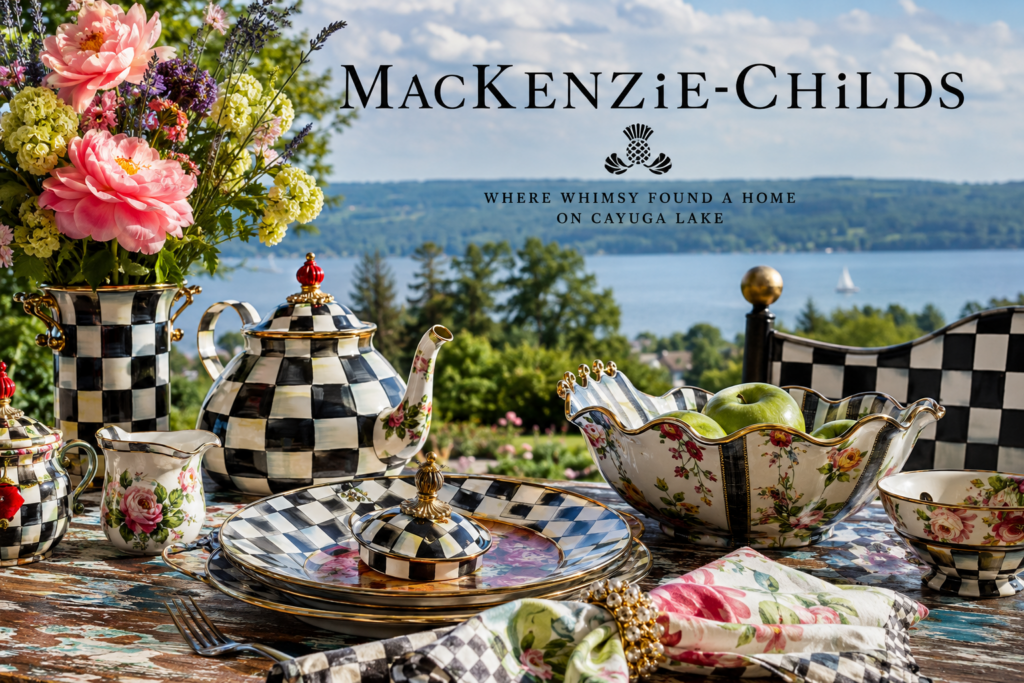
MacKenzie-Childs: Where Whimsy Found a Home on Cayuga Lake
On the eastern shore of Cayuga Lake, where farmland rolls toward the water and the small village of Aurora seems almost suspended between lake and sky, an unlikely design empire took root.
Here, in a corner of the Finger Lakes better known for vineyards, dairy farms and quiet country roads, MacKenzie-Childs developed a style that would become instantly recognizable: black-and-white checks, exuberant florals, unexpected colors and household objects designed to be noticed rather than disappear into the background.
Today, the company is known far beyond the Finger Lakes. But its identity remains closely tied to the landscape and creative spirit of Aurora.
From an Old Farm to a Distinctive American Brand
MacKenzie-Childs traces its beginnings to 1983, when Victoria and Richard MacKenzie-Childs began producing hand-decorated ceramics in Aurora.
What emerged was decidedly different from the restrained housewares of the period. Plates became canvases. Teapots acquired personality. Furniture mixed patterns, colors and decorative details that conventional design rules suggested shouldn’t belong together.
Somehow, they did.
The company’s aesthetic grew around the idea that everyday objects didn’t have to be ordinary. A serving bowl could be playful. A chair could become a conversation piece. Even a kettle sitting on the stove could bring color and character into a kitchen.
That philosophy ultimately helped transform a small Finger Lakes pottery operation into a nationally recognized home-furnishings brand.
The Check That Became an Icon
Of all the patterns associated with MacKenzie-Childs, none is more recognizable than Courtly Check.
Its alternating black-and-white squares appear deceptively simple from a distance. Look more closely, however, and the handmade character becomes apparent. The checks aren’t intended to resemble mechanically perfect geometry. Brushwork, shading and subtle variations give individual pieces their personality.
The pattern can now be found across an enormous range of products—from enamel kettles and serving pieces to lamps, furniture and seasonal decorations.
It has effectively become a visual signature.
You don’t necessarily need to see the company name to recognize a MacKenzie-Childs piece.
A Creative Campus in Aurora
The company’s Aurora property has become a destination in its own right.
The campus sits on a historic farm overlooking Cayuga Lake, surrounded by gardens and countryside that feel distinctly Finger Lakes. Visitors can explore the grounds, shop for MacKenzie-Childs pieces and get a closer look at the creative world behind the brand.
One of the property’s most memorable attractions is the MacKenzie-Childs Farmhouse, where rooms demonstrate what happens when the company’s design philosophy is allowed to run free.
Patterns meet patterns. Floors become decorative statements. Furniture competes cheerfully for attention. Colors that might seem daring in isolation suddenly work together as part of a larger composition.
The result is less a conventional showroom than an invitation to reconsider what a home can look like.
Outside, the experience changes again.
Gardens, lawns, farm buildings and views toward Cayuga Lake remind visitors that this internationally recognized design company did not emerge from Manhattan, Paris or Milan.
It emerged from Aurora, New York.
The Hands Behind the Design
That connection to place is particularly important because MacKenzie-Childs has long emphasized decorative craftsmanship.
Many of the pieces associated with the company depend on human hands for their character. Painting, decorating and finishing introduce small variations from one object to another.
In an era when household products can be manufactured by the millions with almost no visible difference between them, those variations are part of the appeal.
They are evidence of process.
That makes MacKenzie-Childs an interesting continuation of a much older Finger Lakes tradition. Throughout the region, craftspeople have worked in pottery, woodworking, textiles, glass, metal and other decorative arts for generations.
MacKenzie-Childs took that tradition and gave it an unmistakably contemporary—and occasionally theatrical—personality.
When Aurora Becomes a Destination
Perhaps nothing demonstrates the company’s following quite like its celebrated Barn Sale, which has drawn shoppers and collectors to Aurora in search of discounted, discontinued and unusual pieces.
For a small Cayuga Lake community, the influx can be remarkable.
Visitors arrive not simply to purchase housewares but to participate in an experience surrounding the brand. For some collectors, particular patterns or discontinued pieces inspire the same enthusiasm found among collectors of antiques, art or vintage pottery.
That loyalty illustrates something MacKenzie-Childs accomplished particularly well: it turned household objects into objects people form attachments to.
A kettle isn’t merely a kettle when someone remembers receiving it as a wedding gift.
A serving platter becomes associated with Thanksgiving dinners.
A Christmas ornament reappears every December.
Over time, decorated objects become part of family traditions.
A Finger Lakes Success Story
The Finger Lakes is often marketed through its scenery—and understandably so. Waterfalls, vineyards, wooded gorges and eleven glacial lakes provide an extraordinary backdrop.
But the region’s story has always been about more than landscape.
It is also a place where people make things.
Corning became synonymous with glass. Rochester helped transform photography and optics. Agricultural communities built businesses around grapes, apples, dairy products and other crops. Small workshops continue to produce pottery, furniture, jewelry and art.
MacKenzie-Childs belongs to that larger tradition of Finger Lakes creativity.
Its contribution is simply more colorful than most.
From a quiet farm overlooking Cayuga Lake came a company willing to ignore the idea that sophisticated design had to be restrained. Instead, it embraced checks and stripes, flowers and flourishes, bold contrasts and deliberate imperfections.
Four decades later, those choices have created a visual language recognized in homes far beyond New York.
Yet perhaps the best place to understand MacKenzie-Childs remains where the story began.
Drive the country roads into Aurora. Walk the grounds. Look across the fields toward Cayuga Lake. Then step inside and watch an ordinary teapot become something decidedly less ordinary.
In the Finger Lakes, craftsmanship has many forms.
Sometimes, it comes dressed in black-and-white checks.