
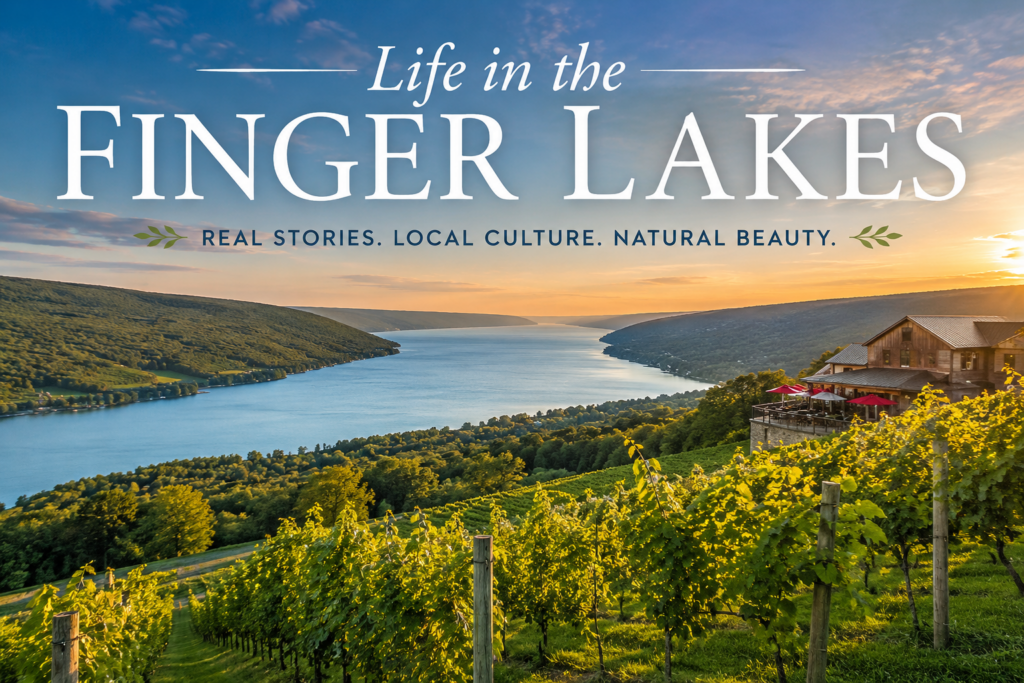
Life in the Finger Lakes: A Region Shaped by Water, Land and Community
There are places where the landscape serves mostly as scenery. In the Finger Lakes, it shapes nearly everything.
The long blue lakes carved into the hills of Upstate New York influence the weather, determine what farmers can grow, draw visitors from around the world and provide the backdrop for communities whose identities have developed along their shores. Vineyards climb hillsides above the water. Waterfalls tumble through deep shale gorges. Main streets lead toward public docks, village parks and historic neighborhoods.
Across the region, life remains closely connected to the geography that created it.
A Landscape Written by Ice
The story begins thousands of years ago, when enormous glaciers advanced and retreated across what is now New York State. Their movement deepened existing river valleys and helped create the distinctive series of long, narrow lakes that today gives the Finger Lakes its name.
Eleven lakes form the geographic heart of the region, although each has developed a character of its own.
Cayuga and Seneca dominate the landscape with their extraordinary length and depth. Keuka is immediately recognizable by its unusual Y shape. Skaneateles is known for remarkably clear water, while smaller lakes such as Canadice and Hemlock remain surrounded by comparatively undeveloped forests.
But the lakes are more than geological landmarks. Their waters moderate temperatures along surrounding slopes, support wildlife and provide drinking water, recreation and economic opportunity.
Forests, wetlands, agricultural fields and waterways combine to create habitats for everything from white-tailed deer and black bears to migrating waterfowl, osprey and bald eagles.
It is a landscape that continues to influence how people live here.
Where Agriculture Meets the Lakes
Drive the rural roads surrounding Seneca, Cayuga and Keuka lakes and another defining feature of the Finger Lakes quickly becomes apparent: agriculture remains deeply woven into the region.
Dairy farms share the countryside with orchards, vegetable growers, maple producers and vineyards. Farm stands appear along two-lane roads throughout the growing season, often selling produce harvested only hours earlier.
Wine has become perhaps the most visible expression of that agricultural heritage.
The lakes create localized growing conditions that help protect vineyards from temperature extremes, particularly along the slopes closest to the water. Riesling has become closely associated with the region, but wineries increasingly produce Cabernet Franc, Chardonnay, Gewürztraminer, sparkling wines and numerous other varieties.
What developed as an agricultural industry has also become an important part of the visitor economy. Wine trails now connect vineyards with restaurants, inns, farms and small communities.
Yet some of the most interesting food stories happen away from the tasting rooms.
Small dairies produce artisan cheeses. Maple producers transform late-winter sap into syrup. Farmers markets bring growers and residents together each week. Bakers, brewers, coffee roasters and food entrepreneurs are finding ways to build businesses around ingredients and traditions rooted in the region.
The result is not simply a culinary destination. It is a food culture tied closely to the land that produces it.
A Region Best Explored Outdoors
The Finger Lakes may be named for its lakes, but some of its most dramatic scenery is found where water leaves them.
Streams cutting through layers of shale have created hundreds of waterfalls, ravines and gorges. State parks preserve some of the best-known examples, but smaller waterfalls remain tucked into forests and along rural roads throughout the region.
Hiking trails offer another way into that landscape.
The Finger Lakes Trail stretches hundreds of miles across New York, passing through forests, parks and rural countryside. Shorter trails lead visitors through gorges, along lakeshores and into wildlife areas.
Places such as the Cumming Nature Center near Naples expand the outdoor experience beyond hiking, offering forests, wetlands, educational programs and seasonal activities that help visitors understand the ecology surrounding them.
The outdoors here does not necessarily demand an expedition.
Sometimes experiencing the Finger Lakes means paddling across a quiet cove at sunrise. Sometimes it is fishing from a village pier, walking beneath autumn maples or sitting beside a waterfall after a summer rain.
The landscape invites participation.
History Around Nearly Every Corner
The Finger Lakes also carries an unusually dense collection of American history.
Long before European settlement, the region was—and remains—part of the homeland of the Haudenosaunee, whose nations profoundly shaped the history and culture of what became New York State.
Later generations added additional chapters.
Seneca Falls became internationally associated with the women’s rights movement following the landmark 1848 convention. Auburn became home to Harriet Tubman during the later years of her life and today preserves important sites connected with her remarkable story.
Elsewhere, historic mills, churches, farmhouses, canal communities and village business districts preserve more localized histories.
Not every important story appears on a historical marker.
Some survive through family farms, community organizations, local museums and traditions handed from one generation to another.
That is one reason the region rewards travelers willing to leave the major highways.
Small Towns Still Matter
Perhaps the Finger Lakes is best understood through its communities.
Villages such as Naples, Hammondsport, Aurora, Skaneateles and Watkins Glen have become familiar destinations, but dozens of smaller communities contribute just as much to the region’s character.
Their identities are often built around remarkably simple institutions: the volunteer fire department, library, church, diner, village park, school, historical society or annual festival.
Those places become gathering points.
Summer brings concerts, farmers markets, boat shows and community celebrations. Autumn arrives with harvest festivals, grape pies and hillsides changing from green to brilliant shades of red and gold. Winter slows the pace but brings its own traditions, from ice fishing and cross-country skiing to maple season waiting just beyond the calendar.
Festivals such as the Naples Grape Festival and the Finger Lakes GrassRoots Festival of Music and Dance have grown far beyond neighborhood gatherings, yet their appeal still rests on something distinctly local: people coming together around food, music, tradition and place.
From Rustic Cabins to Lakeside Luxury
Tourism has changed considerably as the Finger Lakes has gained national recognition.
The traditional cottage, campground and roadside motel remain part of the experience, but they now share the market with restored historic inns, boutique hotels, vacation rentals, destination restaurants and sophisticated spa resorts.
Properties such as the Inns of Aurora and The Lake House on Canandaigua represent the more luxurious side of that evolution.
But luxury is only one interpretation of a Finger Lakes getaway.
For one traveler, the perfect weekend might mean a spa treatment followed by dinner overlooking the lake. For another, it is a campsite, a campfire and coffee beside the water the following morning.
Both experiences belong here.
More Than a Destination
Tourism advertisements understandably focus on waterfalls, vineyards and sunsets.
Living in the Finger Lakes reveals something more complicated—and more interesting.
This is also a working landscape.
Farmers watch the weather. Small businesses navigate changing seasons. Communities debate development and preservation. Volunteers maintain organizations and traditions that might otherwise disappear. Residents wrestle with the same economic and demographic challenges facing rural communities across America.
And yet the connection between people and place remains unusually visible.
The lakes are never merely background. They influence agriculture, recreation, tourism, wildlife and even the rhythms of the seasons. The villages are more than stops between attractions. They are communities with histories and personalities of their own.
That is what makes the Finger Lakes worth exploring beyond the familiar postcard views.
There will always be another waterfall around the bend, another vineyard overlooking the water and another small-town festival waiting for summer.
But the deeper story is found in the people who live between those lakes—and in the many ways the landscape continues to shape their lives.
That is the story of life in the Finger Lakes: not simply a place to visit, but a region to experience, understand and continually rediscover.