
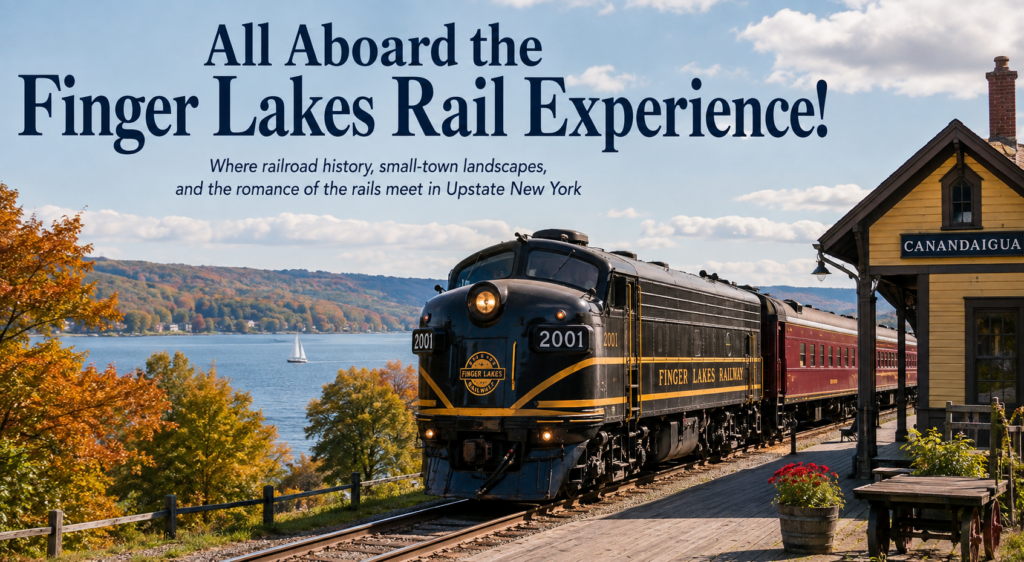
Where railroad history, small-town landscapes, and the romance of the rails meet in Upstate New York
There is something about the sound of a train whistle drifting across the countryside that seems perfectly at home in the Finger Lakes.
Long before automobiles carried visitors from lake to lake, railroads threaded their way through the region, connecting farm communities with cities, carrying vacationers toward lakeside resorts and moving milk, coal, produce and manufactured goods to markets far beyond Upstate New York.
Today, much of that railroad network has disappeared. But the rails have not gone silent.
Across the Finger Lakes and surrounding countryside, historic stations, active rail lines, museums and excursion trains offer visitors a different way to experience the region — one measured not in highway exits, but in whistles, steel rails and stories.
Welcome aboard the Finger Lakes rail experience.
When the Railroad Changed the Finger Lakes
During the 19th and early 20th centuries, the arrival of the railroad could transform a community almost overnight.
Rail connections gave farmers access to distant markets and allowed manufacturers to bring in raw materials and ship finished products. Villages that had once depended largely on wagon roads suddenly became connected to Syracuse, Rochester, Auburn, Ithaca and ultimately the larger cities of the Northeast.
Passenger service changed the region as well.
The Finger Lakes had already begun developing a reputation for dramatic scenery and summer recreation. Railroads made those destinations accessible to people who might otherwise never have traveled into rural Upstate New York.
Travelers stepped from passenger cars onto platforms in communities scattered throughout the region. Hotels, restaurants and businesses grew around stations. In some places, trains connected with steamboats that carried passengers farther along the lakes.
For generations, the railroad station was more than a transportation stop.
It was one of the places where the outside world arrived.
A Landscape Made for Train Travel
The Finger Lakes look different from a train.
From a highway, scenery can pass almost too quickly to absorb. Rail travel slows the landscape down.
A train may follow a creek through a wooded valley, pass behind old barns and farmhouses, cross open fields or slip past industrial buildings that once depended upon the railroad itself.
Then comes the whistle.
A road crossing appears ahead. Cars wait. The locomotive rolls through, and for a few seconds a transportation system that shaped much of Upstate New York becomes very much alive again.
That combination of movement and history is part of what makes excursion railroading so appealing.
You aren’t simply looking at an old locomotive in a museum.
You’re experiencing the railroad doing what it was built to do.
The Finger Lakes Railway
One of the most visible reminders of the region’s railroad heritage is Finger Lakes Railway.
Its locomotives and freight cars remain part of the everyday landscape in communities across the region. The railroad serves customers along a network of former mainline and branch-line routes, keeping rail transportation alive in places where trains have operated for generations.
For residents, seeing a freight train may be an ordinary part of the day.
For anyone interested in railroad history, however, those trains represent something larger: continuity.
The locomotives may be modern, and the cargo may have changed, but the basic purpose remains remarkably familiar — connecting local businesses and communities to a much larger transportation network.
The Excursion Experience
For visitors who want more than trackside watching, tourist and heritage railroads around the broader Finger Lakes region provide the opportunity to climb aboard.
Depending upon the railroad and season, excursions can range from traditional sightseeing trips to autumn foliage rides and special holiday trains.
Autumn may be the most spectacular time to experience the rails.
Imagine settling into a passenger car as the train moves through a landscape of red maples, orange hillsides and weathered barns. A creek flashes between the trees. The conductor walks through the car. Somewhere ahead, the locomotive sounds its horn.
For a moment, the journey becomes the attraction.
That is something modern transportation rarely provides.
Follow the Old Stations
You don’t necessarily need a train ticket to explore Finger Lakes railroad history.
Look closely while traveling through older villages and cities and you can still find clues to the railroad era.
Former depots have been converted into businesses, offices and community spaces. Abandoned grades have become trails. Old freight houses remain beside active tracks. Bridges cross streams where passenger trains once traveled.
Even street patterns can reveal the railroad’s influence.
A road called Railroad Street or Depot Street is rarely accidental.
Find one and there is a good chance you’ve discovered the location of an earlier transportation corridor.
These places can turn an ordinary Finger Lakes road trip into a kind of historical scavenger hunt.
Make It a Rail-and-Road Adventure
A Finger Lakes railroad trip works particularly well as part of a larger day of exploration.
Start with a historic station or rail museum. Follow an old railroad corridor through the countryside. Stop for lunch in a village that once depended upon the railroad. Visit a nearby park, waterfall, winery or lakefront.
Then find a safe public location where you can watch an active train pass.
The result is something different from the traditional Finger Lakes itinerary.
Instead of simply asking, What should we see?, the journey asks another question:
How did people get here before us?
The answer is written across the landscape.
A Story Still Riding the Rails
Railroads helped build the modern Finger Lakes.
They carried agricultural products from farms, workers to factories, travelers to lakeside destinations and generations of residents between communities. Eventually automobiles and highways replaced much of the passenger network, stations closed and miles of track disappeared.
But the railroad story never completely ended.
A locomotive still rounds a bend.
Steel wheels still click across joints in the rail.
A whistle still echoes across a Finger Lakes valley.
And perhaps that is the best reason to seek out the region’s rail experience.
It isn’t simply nostalgia.
It is an opportunity to encounter a living piece of the transportation system that helped shape the communities, industries and landscapes of the Finger Lakes — one mile of track at a time.
11 Lakes Travel Note
Turn this into a “Rails of the Finger Lakes” day trip for the magazine: pair a railroad stop with a historic village, local restaurant, park or waterfall and one of the lakes. It could become a recurring 11 Lakes feature, following a different historic rail corridor in each installment.