
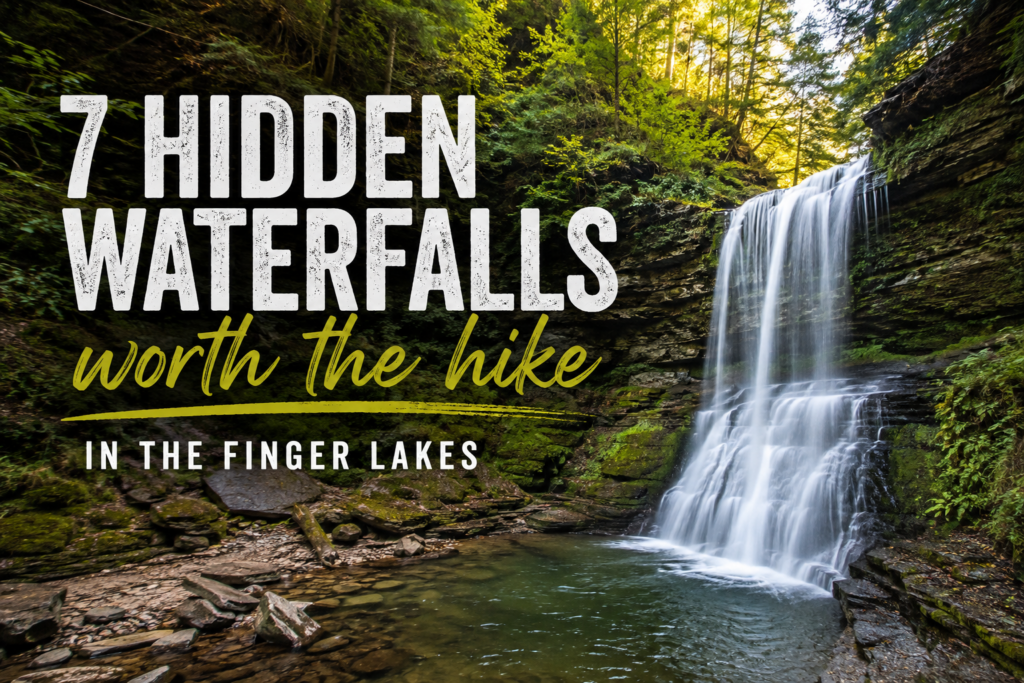
7 Hidden Waterfalls Worth the Hike in the Finger Lakes
Beyond Watkins Glen and Taughannock, some of the Finger Lakes’ most memorable waterfalls are waiting at the end of quieter trails.
There is a moment on certain Finger Lakes hikes when you hear the waterfall before you see it.
At first, it is little more than a low rush somewhere beyond the trees. Then the trail bends, the ravine narrows, and the sound grows louder. A few steps later, there it is—water spilling over layers of ancient rock into a shaded gorge below.
These are not always the waterfalls that appear on postcards.
The Finger Lakes’ famous falls deserve their reputation, but the region is also filled with smaller preserves, wooded hollows and tucked-away ravines where discovering the waterfall is part of the experience.
Some require little more than a walk from the parking area. Others ask for wet shoes, careful footing and a willingness to follow the trail a little farther.
Here are seven worth seeking out.
1. Carpenter Falls — Niles, Cayuga County
Best for: A dramatic waterfall close to home
Hidden in the hills above Skaneateles Lake, Carpenter Falls feels surprisingly wild for a place only a short distance from the road.
Bear Swamp Creek cuts through a steep, forested ravine here before plunging over Upper Carpenter Falls. The surrounding Carpenter Falls Unique Area protects not only the upper waterfall but a second set of falls downstream.
The New York State Department of Environmental Conservation has significantly improved access to the site, including a paved parking area, an accessible observation platform overlooking the approximately 90-foot Upper Carpenter Falls, and a trail with stone steps leading toward a stream-level view.
The main trail through the property is about 0.59 mile and connects with the neighboring Bahar Preserve, opening the possibility of a longer hike through the woods.
What makes Carpenter Falls special isn’t simply its height. It’s the setting.
Hemlocks and hardwoods crowd the walls of the ravine, Bear Swamp Creek tumbles over dark ledges, and the deeper you walk into the forest, the farther away the outside world seems.
11 Lakes Tip: Visit after a period of moderate rain when Bear Swamp Creek is running strongly, but avoid the gorge during high water or severe weather.
2. Tinker Falls — Labrador Hollow
Best for: Maximum scenery with a short walk
Tinker Falls is one of those places that makes you wonder how something so impressive can remain relatively overlooked.
Located within the Labrador Hollow Unique Area near Truxton, the waterfall sits beneath a massive rock overhang carved into the hillside.
The approach is unusually easy for a Finger Lakes waterfall. The DEC’s Tinker Falls Trail runs approximately a quarter-mile each way from the parking area and has a gentle grade and compacted stone surface.
Then the woods open.
Water drops from the limestone ledge into the hollow while the enormous recess behind it gives the entire scene an almost amphitheater-like quality.
Labrador Hollow itself is worth exploring. The surrounding valley was shaped by glaciers thousands of years ago, and today the protected area includes Labrador Pond, wetlands, forest and miles of hiking trails.
It is a place where a quick waterfall stop can easily turn into an afternoon outdoors.
11 Lakes Tip: Pair the falls with the Labrador Hollow boardwalk for two very different landscapes in one trip.
3. Grimes Glen — Naples
Best for: A summer creek-walking adventure
At Grimes Glen, the trail eventually becomes the creek.
And that’s part of the fun.
Located near the southern end of Canandaigua Lake in Naples, the glen was formed as glacial meltwater carved through layers of shale, limestone and sandstone.
Today, hikers follow Grimes Creek upstream through a narrow gorge toward two waterfalls roughly 60 feet high.
The entire outing is relatively short—the maintained trail is about half a mile—but reaching the farther falls can mean walking directly through the shallow creek because the gorge narrows and the shoreline disappears.
Expect wet feet.
On a warm summer day, that feels less like an inconvenience and more like the point of the trip.
Water splashes around your boots. Sunlight filters through the trees overhead. The rock walls rise around you.
And somewhere upstream, you begin hearing the falls.
11 Lakes Tip: Wear shoes designed for wet, slippery surfaces rather than flip-flops. Water levels and trail conditions can change quickly.
4. Conklin’s Gully — Naples
Best for: Experienced hikers looking for something wilder
If Grimes Glen is an introduction to creek walking, nearby Conklin’s Gully—also known as Parish Glen—is the advanced course.
This is not the manicured waterfall experience found at a state park.
The ravine is narrow and rugged, with a succession of cascades appearing as hikers work their way deeper into the gorge.
That wildness is exactly what makes the place remarkable.
There can be steep climbs, slippery rock and sections where turning around may be considerably more difficult than continuing upward. Local hiking guidance specifically warns visitors not to climb beyond their comfort or ability.
For experienced hikers under good conditions, however, Conklin’s Gully offers something increasingly difficult to find: a genuine sense of exploration.
You don’t simply walk to a waterfall here.
You travel through a landscape created by water.
11 Lakes Tip: Treat this as an adventure hike rather than a casual waterfall walk. Check conditions beforehand, wear appropriate footwear and turn around whenever the terrain exceeds your experience level.
5. Tannery Creek — Naples
Best for: Waterfall hunters who don’t mind getting their boots wet
Naples could almost support a waterfall tour of its own.
While visitors frequently head toward Grimes Glen, Tannery Creek offers another creek-walking experience nearby.
The route follows the stream through a wooded ravine and passes a succession of smaller cascades before reaching a waterfall roughly 40 feet high.
There are no grand stone staircases here.
Instead, the experience is about following the creek itself—stepping over rocks, crossing shallow water and watching the landscape slowly close around you.
It feels intimate rather than monumental.
And sometimes that is exactly what makes a waterfall memorable.
11 Lakes Tip: Save this one for lower-water conditions. Creek routes can become hazardous after heavy rain.
6. Clark Gully — Near Naples
Best for: Hikers who enjoy discovering what is around the next bend
Clark Gully is another reminder that some of the Finger Lakes’ best scenery exists outside the major parks.
The attraction here isn’t necessarily one enormous waterfall.
It is the ravine.
Water has worked through the landscape for thousands of years, producing cascades, ledges and exposed layers of rock along the creek.
The result is the sort of place where hikers naturally slow down.
A small cascade appears.
Then another.
The gorge changes.
The light changes.
And suddenly the walk itself becomes more important than reaching a single destination.
Clark Gully is particularly appealing to people who have already visited the Finger Lakes’ major waterfall attractions and want something quieter and less structured.
11 Lakes Tip: Conditions matter enormously in undeveloped gullies. Don’t enter during high water, thunderstorms or icy conditions.
7. Lower Carpenter Falls & the Bahar Preserve —
Niles
Best for: Turning a waterfall stop into a real hike
Most visitors arriving at Carpenter Falls naturally head toward the spectacular upper waterfall.
Keep exploring.
The Carpenter Falls Unique Area trail continues across the property toward Lower Falls, while its connection with the Finger Lakes Land Trust’s neighboring Bahar Preserve adds approximately 1.6 miles of additional trails and access to another picturesque waterfall.
Together, the properties create something much better than a roadside photo stop.
They create a waterfall hike.
The landscape changes as you travel along Bear Swamp Creek—water rushing over ledges, hardwood forest rising from the slopes and glimpses of the ravine appearing through the trees.
It is particularly beautiful when summer green begins giving way to the first yellows and oranges of autumn.
And because many visitors never venture far beyond Upper Carpenter Falls, walking farther can reveal a noticeably quieter side of the preserve.
11 Lakes Tip: Give yourself enough time to explore rather than treating Carpenter Falls as a ten-minute stop.
The Finger Lakes Were Made for Waterfalls
To understand why there are so many waterfalls here, you have to look backward—thousands of years.
Glaciers reshaped this landscape, carving deep valleys and leaving tributary streams high above them. Over time, those streams cut downward through layers of shale, sandstone and limestone.
The result is the landscape we know today.
Gorges.
Ravines.
Creeks.
And waterfalls—hundreds of them scattered across the region.
Some became famous.
Others remained hidden in the woods.
Perhaps that’s why finding one still feels special.
You leave the road behind. The sound of traffic disappears. The trail grows narrower.
Then somewhere ahead comes that unmistakable sound of rushing water.
You follow it.
And for a little while, you’ve found one of the Finger Lakes’ hidden places.
Before You Go
Waterfall environments can change dramatically with rain, erosion, ice and seasonal trail conditions. Stay on designated trails where provided, obey posted closures and property rules, and never assume that a route beside or behind a waterfall is safe simply because others have traveled it.
Good footwear matters. So does knowing when to turn around.
And leave the gorge exactly as you found it.
11 Lakes Magazine — Stories from the Finger Lakes
There is always another road to follow, another trail to walk—and another story waiting just around the bend.