
Where the Vineyard Meets the Creamery
Finding the perfect pairing in the Finger Lakes
There is a particular kind of afternoon in the Finger Lakes when no one seems especially interested in hurrying.
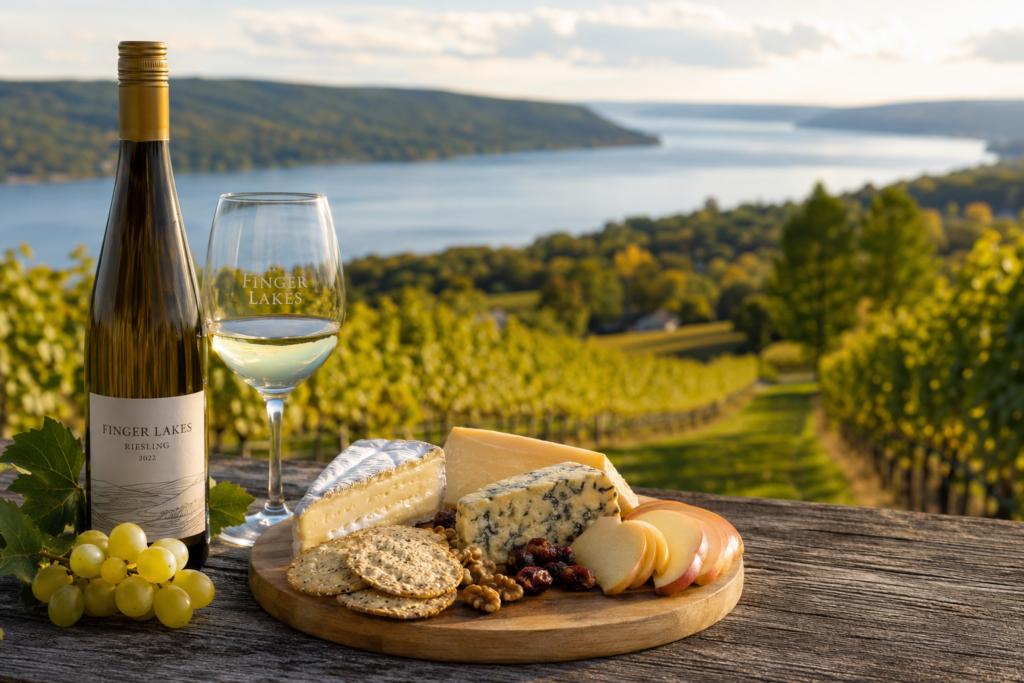
The vineyard rows stretch toward the water. A breeze comes off the lake, carrying just enough cool air to soften the warmth of the sun. On the table sits a bottle of Riesling, a wedge of local cheese, a handful of crackers and perhaps a few late-summer apples.
Nothing about the scene is complicated.
And that may be precisely why wine and cheese belong together here.
Across the Finger Lakes, winemaking and cheesemaking share much of the same landscape. Both depend on agriculture. Both are influenced by season, soil and weather. Both reward patience. And both have become part of a regional food culture that is increasingly interested not simply in what is made here, but in how the flavors of one Finger Lakes product can complement another.
The result is an invitation to explore the region one glass—and one bite—at a time.
The lakes behind the wine
Wine in the Finger Lakes begins with geography.
The deep glacial lakes that define the region help moderate temperatures in the vineyards surrounding them. In autumn, that influence can extend the growing season and give grapes additional time to ripen. The hillsides also provide drainage and exposure that have helped make the region particularly well suited to cool-climate varieties.
Riesling has become the best-known example, but it is hardly alone.
Gewürztraminer, Chardonnay, Pinot Noir and Cabernet Franc are among the varieties that have helped build the Finger Lakes’ reputation. Sparkling wines have also found a natural home here, while winemakers continue experimenting with styles ranging from bone-dry whites to dessert wines.
For the visitor, that diversity presents an interesting problem:
What should we eat with all of it?
Cheese is a very good place to start.
Riesling: the Finger Lakes classic
If there is a bottle that belongs at the center of a Finger Lakes cheese board, Riesling makes a convincing case.
Dry Riesling’s acidity can cut through the richness of cheese while its fruit and mineral qualities provide contrast. Try it with a young goat cheese or a creamy chèvre. The bright character of the wine plays against the tanginess of the cheese without overwhelming it.
Move toward an off-dry Riesling and the possibilities broaden.
A slightly sweeter Riesling can work beautifully with a more assertive cheese, particularly one with saltiness or a little funk. Blue cheese can be surprisingly successful—the sweetness of the wine softens the cheese’s sharp edge while the salt in the cheese makes the fruit in the wine seem even more pronounced.
It is a pairing built on contrast rather than similarity.
And sometimes contrast produces the most interesting conversation.
Cabernet Franc: bring out the aged cheese
Cabernet Franc has become one of the Finger Lakes’ signature reds, particularly for drinkers who appreciate wines with red-fruit flavors, moderate body and savory or herbal notes.
This is where the cheese board can become a little heartier.
An aged cheddar is an excellent companion. Its concentrated flavor and crumbly texture have enough character to stand beside the wine without burying it.
A nutty alpine-style cheese can work equally well.
Add toasted walnuts, dried cherries or a thin slice of local apple and suddenly the pairing becomes less like a tasting exercise and more like something that belongs beside a fireplace on an October evening.
Chardonnay: think creamy
Finger Lakes Chardonnay can take several forms, which makes the wine particularly interesting for pairing.
A crisp, unoaked Chardonnay calls for something relatively fresh and mild. Try a soft cow’s-milk cheese or young Gouda.
A richer Chardonnay that has spent time in oak can handle something more substantial: aged Gouda, buttery cheeses or even a mild washed-rind cheese.
There is a useful rule hiding here.
Match intensity with intensity.
A delicate wine can disappear behind a powerful cheese. A subtle cheese can become almost invisible beside a bold wine. Neither needs to dominate the other.
The best pairings allow you to notice something new in both.
Pinot Noir: an invitation to experiment
Pinot Noir generally prefers a little restraint at the cheese table.
Rather than reaching immediately for the strongest cheddar available, consider Brie, Camembert-style cheese or a mild mushroomy soft-ripened cheese.
Pinot Noir’s red-fruit and earthy characteristics can echo the earthy qualities of the rind while its acidity helps balance the creamy interior.
For an autumn board, add mushrooms, roasted nuts or dried cranberries.
Suddenly the pairing begins to taste like the season surrounding it.
Sparkling wine: the underestimated partner
There is another bottle worth remembering when assembling a Finger Lakes cheese board: sparkling wine.
Bubbles and acidity are remarkably effective at refreshing the palate after rich, creamy cheese.
Triple-cream cheeses are natural candidates. So are Brie-style cheeses and fresh cheeses that might otherwise seem too mild for a serious wine tasting.
Sparkling wine also makes an excellent starting point when several cheeses are being served. Instead of searching for one perfect combination, pour the bubbles, put three or four cheeses on the board and experiment.
That is part of the pleasure.
Ice wine and blue cheese: save this one for last
For a pairing that feels almost like dessert, bring together a sweet Finger Lakes wine and blue cheese.
The combination sounds aggressive on paper.
On the palate, it can be extraordinary.
The concentrated sweetness and acidity of dessert wine meet the intense saltiness of blue cheese somewhere in the middle. Neither disappears. Instead, each seems to exaggerate the best qualities of the other.
Serve very small portions.
This isn’t a pairing meant to be rushed—or consumed by the plateful.
Build a Finger Lakes board
A regional wine-and-cheese board does not need to become an elaborate culinary project. In fact, simplicity often makes the tasting more interesting.
Choose three cheeses: one fresh and mild, one aged and firm, and one bold. Add a loaf of crusty bread or neutral crackers. Then bring in a few ingredients that connect the board to the surrounding countryside—apples, pears, grapes, honey, maple products, preserves or roasted nuts.
Open two wines rather than six.
Perhaps a Riesling and Cabernet Franc.
Taste the cheese first. Then taste the wine. Then try them together.
The question isn’t simply, Do I like this?
Ask instead:
What changed?
Did the wine suddenly taste fruitier? Did the cheese seem creamier? Did a flavor appear that wasn’t obvious before?
That small moment of discovery is what pairing is really about.
More than something to eat
Wine and cheese pairing can easily become intimidating when reduced to rules: this grape with that cheese, this vintage at that temperature, this particular glass.
The Finger Lakes offers a much friendlier interpretation.
Here, wine and cheese tell overlapping agricultural stories.
One begins in vineyards descending toward glacial lakes. Another begins in pastures, barns and creameries scattered across the countryside. Their paths eventually meet at farm stores, tasting rooms, farmers markets, restaurants—and kitchen tables.
Perhaps that is the pairing worth remembering most.
The next time you travel one of the Finger Lakes wine trails, leave a little room in the cooler.
Pick up a bottle from a winery you have never visited before. Stop for a locally made cheese. Find some bread, apples and perhaps a jar of local honey.
Then find a porch, picnic table or quiet place overlooking the water.
Open the bottle.
Cut the cheese.
And forget the rules for a while.
In the Finger Lakes, discovering what belongs together is half the fun.