
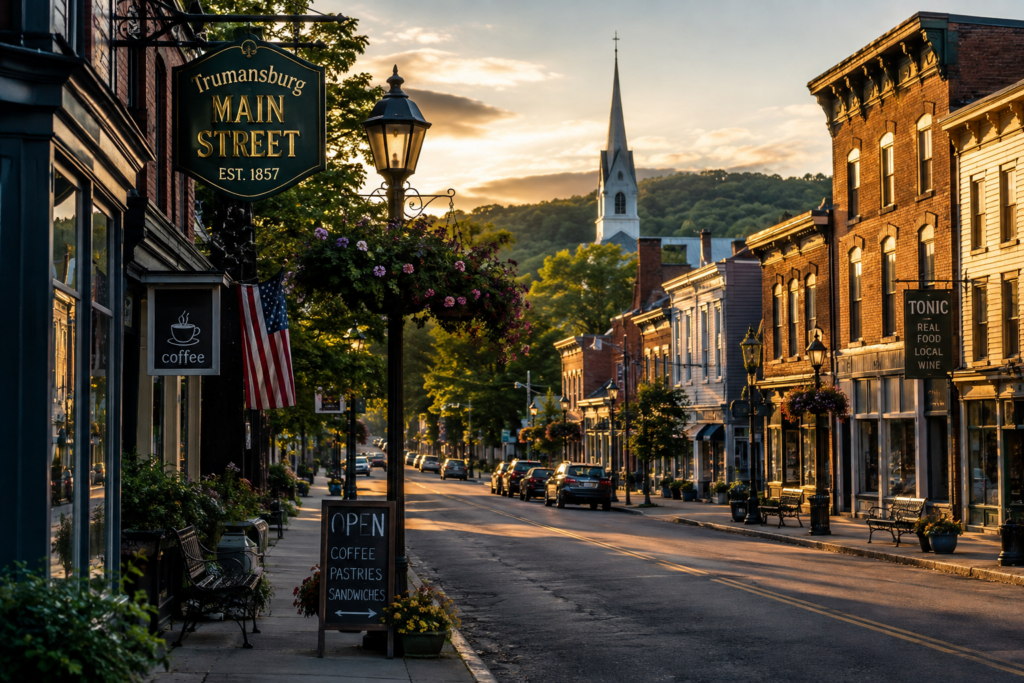
The Villages Between the Lakes
Where the Finger Lakes Still Feel Like Home
By 11 Lakes Magazine
The Finger Lakes are usually introduced through water.
Eleven long blue lakes stretch across the landscape. Vineyards climb their hillsides. Waterfalls disappear into deep gorges. Visitors arrive with cameras, tasting-room reservations and maps marked with places they hope to see before heading home.
But between those lakes is another Finger Lakes.
It is found along two-lane roads where the speed limit suddenly drops to 30. A church steeple appears above the trees. Houses move closer to the road. There’s a fire station, a library, perhaps a diner or hardware store, and a Main Street that has been serving the surrounding countryside for generations.
These are the villages between the lakes.
And in many ways, they tell the story of the Finger Lakes better than the lakes themselves.
Morning on Main Street
The day begins quietly.
Before the tourist traffic arrives and before the sidewalks become busy, lights come on behind storefront windows. Someone unlocks a restaurant. A delivery truck stops along the curb. Coffee is poured for people who don’t need a menu.
These aren’t carefully constructed scenes of small-town America. They’re simply daily life.
Across the Finger Lakes, villages grew because people needed them. Farmers needed mills and markets. Travelers needed inns. Families needed churches, schools and stores. Industry needed water, roads and eventually railroads.
Main Street became the place where those needs met.
Some of those original businesses are gone. Others have survived under different names and owners. Banks have become offices. Old storefronts have become cafés, antique shops, galleries and apartments.
But the bones of the villages remain.
Walk slowly enough and you can still see them.
Moravia: A Village at the Southern Gateway
In southern Cayuga County, Moravia sits near the southern end of Owasco Lake, surrounded by farmland and hills.
Travelers headed toward Ithaca or Auburn can pass through quickly.
They shouldn’t.
This is the kind of community where the Finger Lakes landscape and its history come together within a remarkably small area.
Just outside the village, Fillmore Glen State Park follows a narrow gorge carved into the hillside. Trails pass waterfalls, stonework and deep woods that can make the outside world seem surprisingly distant.
The park also carries the name of Millard Fillmore, the nation’s 13th president, who was born nearby in 1800.
Yet Moravia’s story isn’t preserved only in historical markers.
It continues along Main Street, in the library, churches, businesses, homes, village parks and conversations between people who have known one another for decades.
It is not a resort town.
And that may be exactly what makes it important.
Moravia offers something increasingly difficult to manufacture: a community that still primarily exists for the people who live there.
Aurora: Where the Village Meets the Lake
Travel north and west toward Cayuga Lake and the landscape changes.
Then, almost suddenly, there is Aurora.
The village occupies a narrow strip along Cayuga Lake’s eastern shore, where historic buildings stand within sight of the water.
Aurora feels different from Moravia, but the underlying story is similar.
Its history is visible everywhere—in old homes, churches and buildings associated with Wells College. The lake is never far away, and the relationship between village and shoreline gives Aurora an intimacy that larger waterfront communities rarely achieve.
Visitors may come for the scenery.
Residents experience something else entirely.
They see the lake in November rain and February snow. They watch summer crowds disappear. They know which roads drift shut during storms and where the sun falls across the water in October.
That distinction matters.
There is the Finger Lakes people visit.
And there is the Finger Lakes people live in.
Hammondsport: At the Head of Keuka
At the southern end of Keuka Lake, Hammondsport gathers around a village square.
Few places demonstrate the layers of Finger Lakes history quite as clearly.
Wine is part of that story, but so is transportation, agriculture and aviation. Nearby, Glenn Curtiss helped pioneer early flight and became one of America’s most important aviation innovators.
The surrounding hills tell another story.
Vineyards follow slopes above Keuka Lake, continuing an agricultural tradition that has transformed the region’s economy and identity.
Yet step away from the wineries and the village itself remains the center of the experience.
People sit outside cafés. Visitors wander through shops. Residents stop to talk.
The lake may bring people here.
The village persuades them to stay awhile.
Naples: Where the Hills Close In
Farther west, Naples sits among steep hills at the southern end of Canandaigua Lake country.
This is grape country.
For generations, vineyards have shaped the hillsides and the local economy. Each autumn, the grape harvest becomes part agriculture, part celebration.
But Naples demonstrates something important about Finger Lakes villages.
Their identities are often tied not simply to a lake, but to the land surrounding it.
The soil matters.
The hills matter.
The farms matter.
And traditions emerge from all three.
A grape pie cooling on a kitchen counter can tell as much about this region as a bottle from an acclaimed winery.
Perhaps more.
Penn Yan: Where Agriculture Meets the Lake
At the northern end of Keuka Lake, Penn Yan serves as both a lake community and an agricultural center.
The countryside surrounding it contains vineyards, farms and one of New York’s significant Mennonite communities.
That mixture gives the village a rhythm different from communities built primarily around tourism.
On the same road, you may encounter vacation traffic, farm equipment and a horse-drawn buggy.
It is a reminder that the Finger Lakes isn’t one place.
It is several worlds occupying the same landscape.
Trumansburg: A Village With Its Own Rhythm
Near Cayuga Lake, Trumansburg has developed another variation on the Finger Lakes village.
Its Main Street has restaurants, shops and gathering places, while nearby Taughannock Falls draws visitors from around the world.
But Trumansburg has maintained something that many small communities struggle to preserve—a recognizable identity separate from the attraction beside it.
It feels like a place rather than simply a gateway.
That difference is subtle.
It is also enormously important.
The Main Streets That Almost Disappeared
The story of these villages isn’t entirely romantic.
Small-town America has changed.
Interstate highways redirected travelers. Shopping centers drew customers away from downtowns. Large retailers replaced independent stores. Manufacturing jobs disappeared. Young residents left for larger cities.
Some storefronts never reopened.
Some buildings were demolished.
Some communities spent decades wondering whether their best years were behind them.
The Finger Lakes were not immune.
Yet something unexpected has happened in many villages.
People have begun looking at them again.
Historic buildings are being restored. Old storefronts are finding new uses. Restaurants occupy spaces once considered obsolete. Artists and craftspeople are opening studios. Visitors increasingly seek places that feel authentic rather than manufactured.
The very characteristics that once seemed old-fashioned—walkable streets, historic buildings, independent businesses and strong local identities—have become valuable again.
Tourism Is Both Opportunity and Challenge
That renewed interest brings its own questions.
Tourism supports restaurants, wineries, shops, lodging and attractions throughout the Finger Lakes.
It creates jobs and gives entrepreneurs opportunities that might otherwise be impossible in small communities.
But successful tourism can change a place.
Housing becomes more expensive. Short-term rentals replace year-round neighbors. Businesses begin serving visitors rather than residents. Main Streets can slowly become destinations instead of communities.
The challenge is not choosing between tourism and local life.
It is finding room for both.
Because the most appealing Finger Lakes villages are often those that haven’t forgotten why they existed before tourists discovered them.
Take the Road Through Town
Modern travel encourages efficiency.
GPS finds the fastest route.
Highways bypass villages.
We measure trips by how quickly we can reach the destination.
Perhaps the Finger Lakes deserve a different approach.
Take the old road occasionally.
When the speed limit drops, don’t resent it.
Slow down.
Notice the houses.
Look at the dates carved into old buildings.
Stop at the bakery.
Walk into the library.
Buy something from the small shop instead of waiting until you reach the next chain store.
Sit on a bench for ten minutes.
You may discover that the place you were passing through was part of the destination all along.
What Lies Between the Lakes
The great lakes will always define this region on a map.
Cayuga. Seneca. Keuka. Canandaigua. Skaneateles. Owasco and the others.
But geography alone doesn’t create a region.
People do.
They build houses and businesses. They plant trees. They establish churches and libraries. They organize festivals and volunteer fire departments. They argue about taxes and sidewalks and development. They restore old buildings. They mourn businesses that close and celebrate new ones that open.
Generation after generation, they create a place worth belonging to.
That story rarely appears on a postcard.
Perhaps it should.
Because beyond the vineyards and waterfalls, beyond the tasting rooms and scenic overlooks, another Finger Lakes is waiting along the old roads.
You’ll know you’ve found it when the speed limit drops.
And Main Street begins.