
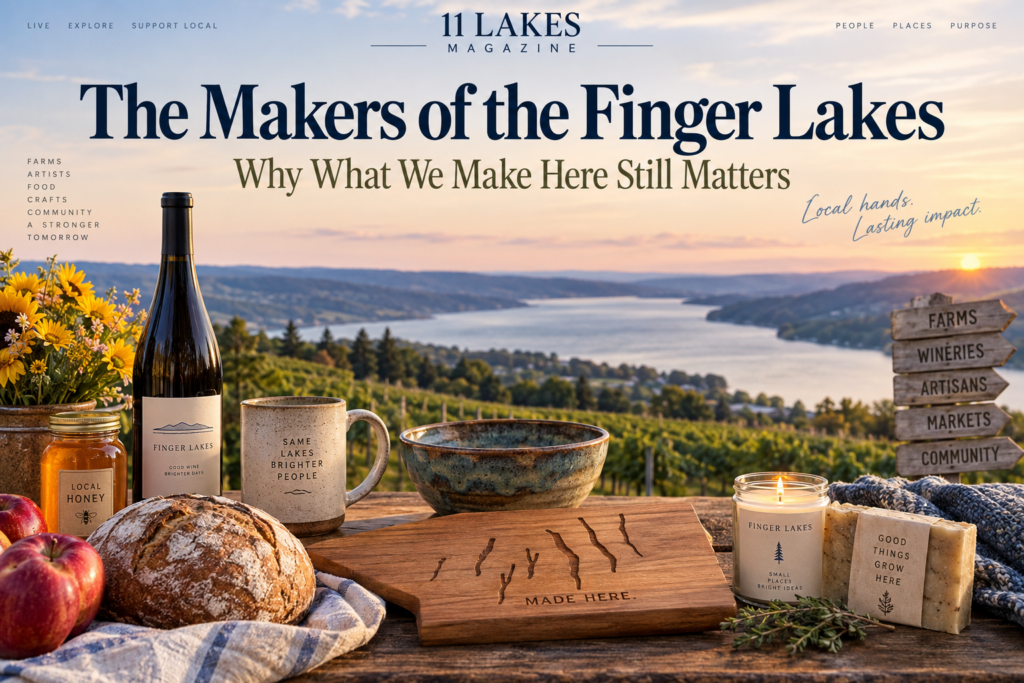
Across the Finger Lakes, there is still a strong belief in making things by hand.
You can see it at a farmstand where jars of jam sit beside fresh bread. You can find it in a small pottery studio tucked behind a village home, in a woodshop scented with sawdust, at a vineyard bottling a new vintage, or in a market booth filled with candles, quilts, honey, soap, jewelry, maple syrup, and carefully crafted gifts.
These things may seem small when compared with factories, national brands, and overnight delivery.
But they are not small at all.
They are part of what gives the Finger Lakes its character.
And in an era when nearly anything can be ordered with a few taps on a phone, what we make here may matter more than ever.
A Region That Has Always Made Things
Long before the Finger Lakes became known nationally for wine, waterfalls, and weekend getaways, this was a working landscape.
Farmers raised crops and livestock. Blacksmiths repaired tools. Mills processed grain and lumber. Families preserved food for winter. Furniture, clothing, household goods, wagons, barrels, baskets, and equipment were often produced close to home because they had to be.
Every village depended on people who knew how to make, repair, grow, bake, build, and create.
Those skills helped sustain rural communities.
The modern Finger Lakes economy is very different, but the instinct to create has never disappeared.
Today, the blacksmith shop may have become a woodworking studio. The family dairy may now produce artisan cheese. A former barn might house a pottery kiln, a small brewery, or a floral business. Someone working from a spare bedroom may design prints or jewelry sold across the country.
The tools have changed.
The spirit has not.
More Than a Product
There is something noticeably different about buying something made locally.
A handmade mug carries the marks of the person who shaped it. A jar of honey reflects the fields and blossoms surrounding the beekeeper’s hives. A bottle of wine tells the story of a particular hillside, season, and harvest.
Even an ordinary loaf of bread can become a connection to place when you know who baked it and where the ingredients came from.
That connection is difficult to mass-produce.
Large manufacturers are exceptionally good at producing things efficiently and consistently. Local makers offer something else: identity.
Their products often carry a little of the Finger Lakes with them.
A cutting board might be made from regional hardwood.
A candle may be named after a lake or village.
A photographer may capture morning fog rising over Cayuga Lake.
A fiber artist may work with wool from a nearby farm.
A ceramic artist may shape bowls inspired by the colors of the region’s water and hills.
These objects become more than merchandise.
They become small expressions of where they came from.
The New Rural Creative Economy
One of the most interesting developments across rural America is the growth of very small businesses.
Not every successful business needs a storefront, a factory, or dozens of employees.
A maker may operate from a garage, barn, kitchen, studio, or workshop.
Online marketplaces and social media allow a craftsperson in a small Finger Lakes community to reach customers hundreds or even thousands of miles away.
Farmers markets and seasonal festivals provide another route to customers.
So do cooperative shops, farm stores, tourism destinations, wineries, breweries, and locally focused retailers.
This has created what might be called a rural creative economy — one built around many small enterprises rather than a handful of large employers.
Individually, these businesses may appear modest.
Collectively, they can have a substantial impact.
They purchase supplies.
They rent spaces.
They hire photographers, designers, printers, accountants, and contractors.
They attract visitors.
They fill market stalls.
They bring activity to village streets.
And perhaps most importantly, they allow people to build livelihoods without necessarily leaving the communities they call home.
When Tourism Meets Craftsmanship
The Finger Lakes welcomes millions of visitors drawn to wineries, lakes, state parks, waterfalls, historic sites, and small towns.
But visitors increasingly want more than scenery.
They want experiences.
They want to meet the winemaker.
They want to see cheese being made.
They want to walk through an orchard.
They want to visit a pottery studio.
They want to browse a village market and return home with something that could only have come from this region.
That creates an important opportunity for local makers.
The future of Finger Lakes tourism may depend partly on how successfully communities connect visitors with the people who actually produce things here.
A traveler might arrive because of Watkins Glen or Taughannock Falls.
But what they remember could be the maple syrup purchased from a roadside farm, the handmade bowl discovered at a craft market, or the conversation they had with an artist working in a converted barn.
Those encounters turn tourism into something more personal.
The Farmers Are Makers Too
When people hear the word maker, they often think first of crafts.
But farmers may be among the Finger Lakes’ most important makers.
They make food.
And increasingly, they transform that food into finished products.
Milk becomes cheese.
Apples become cider.
Grapes become wine.
Grain becomes bread.
Maple sap becomes syrup.
Berries become preserves.
Herbs become teas and seasonings.
This kind of value-added agriculture can be especially important for small farms.
Instead of selling only a commodity, the farmer creates a product with a story, a brand, and a direct relationship with the customer.
The same acre of land can suddenly support more economic activity.
For rural communities trying to preserve farmland while strengthening local economies, that matters enormously.
Why Buying Local Has a Ripple Effect
When someone buys from a local maker, the transaction rarely ends with that one person.
The money tends to circulate.
The potter may purchase clay and packaging locally.
The bakery may buy fruit from a nearby farm.
The gift shop may carry products from several regional artists.
The farmer may hire a local contractor to repair a barn.
The winery may work with a regional printer for labels.
The maker may spend earnings at another village business.
Local economies are complicated, but one principle is relatively simple: money spent close to home has more opportunities to remain close to home.
That does not mean every purchase must be local.
Modern life depends on national and international trade.
But choosing local when possible helps maintain the small economic ecosystems that keep rural communities alive.
Keeping Skills Alive
There is another reason makers matter that is harder to measure.
They preserve knowledge.
Somewhere in the Finger Lakes, someone still knows how to repair an old stone wall.
Someone knows how to graft an apple tree.
Someone knows how to weave, quilt, carve, forge, preserve, ferment, bake, smoke, press, throw pottery, or build furniture.
These skills can disappear remarkably quickly when one generation stops teaching the next.
Supporting local makers helps create a reason for those traditions to continue.
Sometimes the traditions evolve.
A woodworker may use computer-controlled equipment alongside hand tools.
A farmer may combine generations of agricultural knowledge with drones, sensors, and precision equipment.
An artist may sketch by hand but sell work through an online store.
Tradition and technology do not have to compete.
Often, they strengthen one another.
The Value of Imperfection
Mass production has taught us to expect identical products.
Every bottle looks the same.
Every plate is symmetrical.
Every shirt is cut from the same pattern.
Handmade things can be different.
Wood grain changes from one board to another.
Glaze settles differently on each piece of pottery.
A hand-poured candle may vary slightly.
A batch of jam reflects the fruit available that season.
These differences were once considered flaws.
Increasingly, people appreciate them as evidence that a human being made the object.
Imperfection can be a signature.
It reminds us that the thing we are holding did not simply emerge from an anonymous production line.
Someone made it.
Markets as Community Gathering Places
Visit a good farmers market or craft market and something becomes obvious.
People are not there only to shop.
They talk.
They ask questions.
They sample food.
They meet neighbors.
They learn where products come from.
They discover businesses they never knew existed.
Markets create a kind of temporary Main Street — a gathering place where commerce and community overlap.
For small villages across the Finger Lakes, that social function may be nearly as important as the economic one.
A thriving maker culture gives people reasons to gather.
And communities need reasons to gather.
The Challenge of Staying Small
Making things locally is rarely easy.
Small producers often face higher material costs than large manufacturers.
Shipping can be expensive.
Insurance, permits, packaging, equipment, and marketing all add up.
Farmers deal with weather and volatile commodity prices.
Artists and craftspeople must balance production with the constant work of selling their products.
Many operate without large financial cushions.
That means the survival of small businesses can depend heavily on community support.
Not charity.
Customers.
There is an important distinction.
Makers do not simply need encouragement.
They need people who value what they produce enough to purchase it.
A Different Definition of Economic Development
Economic development is often discussed in terms of large numbers.
How many jobs will a project create?
How large is the investment?
How many square feet will be built?
Those questions are important.
But rural communities may also need a second definition.
What if economic development also means helping 50 small businesses each become slightly stronger?
What if it means helping a farmer create a new product line?
What if it means converting an empty storefront into a shared retail space for local makers?
What if it means creating seasonal markets that bring visitors into a village?
What if it means helping someone turn a weekend hobby into a viable small business?
There may never be a ribbon-cutting for that kind of development.
But over time, it can transform a community.
Made Here Still Means Something
There is a certain pride in picking something up and knowing where it came from.
Not just the country stamped on the bottom.
The place.
The town.
The farm.
The studio.
The person.
In the Finger Lakes, that sense of connection still exists.
You see it when someone recommends a local cheese maker.
You hear it when residents tell visitors where to find the best maple syrup.
You notice it when a craft market becomes crowded on a Saturday morning.
You feel it when someone says, with a little pride:
“That’s made right here.”
Those four words still matter.
Maybe they always will.
Because the Finger Lakes is not simply a landscape of lakes, vineyards, waterfalls, and rolling hills.
It is also a region shaped by people who make things.
Farmers.
Artists.
Bakers.
Woodworkers.
Winemakers.
Potters.
Designers.
Craftspeople.
Entrepreneurs.
People turning raw materials, ideas, tradition, and imagination into something tangible.
And every time we choose something grown, crafted, designed, baked, bottled, carved, sewn, printed, or built here, we help ensure that tradition continues.
The Finger Lakes will always be known for what nature created.
But part of its future may depend on remembering the importance of what we create here, too.