
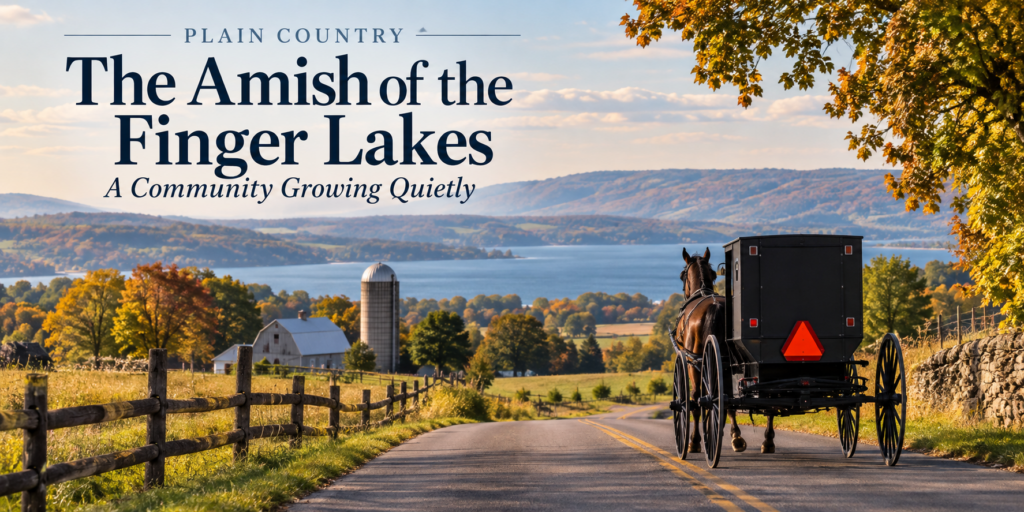
The Amish of the Finger Lakes: A Community Growing Quietly
Part 1
Along the back roads of the Finger Lakes, an old way of life is becoming an increasingly familiar part of the landscape.
Drive far enough beyond the villages and lakefront communities of the Finger Lakes and the landscape begins to change.
The vineyards may give way to hayfields. A hand-painted sign beside a farmhouse might advertise eggs, baked goods, vegetables or maple syrup. On the shoulder ahead, an orange slow-moving-vehicle triangle appears on the back of a black horse-drawn buggy.
For many residents of rural Central New York, these are no longer unusual sights.
Amish families have become part of the agricultural landscape across portions of the Finger Lakes and surrounding counties. Their presence is particularly noticeable away from the region’s tourism corridors, in places where farmland remains available and small-scale agriculture is still possible.
Yet despite seeing Amish neighbors at farm stands, stores and along country roads, many of us know relatively little about them.
That makes their story worth telling.
A New Chapter in an Old Landscape
The Amish story in America stretches back centuries, but the growth of Amish communities in New York is a more recent chapter.
New York has seen substantial Amish settlement and expansion, particularly since the latter half of the twentieth century. Families have established communities across rural parts of the state, including areas of Western and Central New York and the broader Finger Lakes region.
The reasons are practical as much as cultural.
Amish families generally need land.
Agriculture has traditionally occupied an important place in Amish life, and as established Amish communities in Pennsylvania, Ohio and other states grew, affordable farmland became increasingly difficult for younger families to obtain.
Rural New York offered another possibility.
Here were farms that could sometimes be purchased for less than comparable agricultural land in older Amish settlements. There were barns, pastures and country roads—and communities where small farms had been disappearing for generations.
In some places, Amish migration has brought families back onto land that might otherwise have left agricultural production altogether.
An old dairy farm can become active again.
Fields are planted.
Fences are repaired.
Barns once again hold livestock.
And another family becomes part of the countryside.
Not One Amish Community
One of the easiest mistakes outsiders make is assuming that “the Amish” are a single, uniform community.
They aren’t.
Individual Amish settlements are divided into church districts, and practices can differ significantly from one community to another.
Rules governing clothing, transportation, machinery, telephones and other technology may vary. Some communities permit equipment or practices that others reject.
These expectations are shaped by the Ordnung—the collection of traditions and rules governing life within a particular Amish community.
That helps explain something that can occasionally puzzle outsiders.
One Amish farmer may use a piece of equipment that another Amish farmer would never consider using.
One community may permit limited telephone access while another maintains stricter separation.
The underlying objective is generally not simply to reject technology because it is modern.
The larger question is what effect a technology may have on family, church and community.
That distinction is important.
Life Without the Automobile
Perhaps the most visible difference between Amish families and their non-Amish neighbors is transportation.
The horse and buggy remains one of the defining features of Amish life.
On Finger Lakes roads, however, that tradition meets a transportation system built almost entirely around automobiles.
A buggy traveling at perhaps the speed of a horse shares pavement with cars and trucks moving many times faster.
That creates one of the most important points of interaction between Amish and non-Amish residents: road safety.
Drivers encountering a buggy need to slow down early, allow plenty of room and pass only when visibility makes it safe.
Hills and curves make this particularly important on rural Finger Lakes roads.
The horse is not simply another vehicle. It can react to sudden noises and unexpected movements.
For those of us driving automobiles, a few seconds of patience can make an enormous difference.
The One-Room Schoolhouse
Another visible sign that an Amish settlement has taken root is the schoolhouse.
Amish children commonly attend small private schools located within their communities. A single building may serve children of several ages, with instruction emphasizing reading, writing, arithmetic and practical knowledge.
The school is more than an educational institution.
It keeps children close to home and places education within the community rather than outside it.
For visitors accustomed to large school districts, buses, athletic complexes and computer-equipped classrooms, the contrast can be striking.
But understanding Amish education requires seeing it within a much larger system.
Children learn not only in school but through family and community life. Farm work, homemaking, trades and practical skills become part of their education as they grow older.
An Economy Hidden in Plain Sight
It is tempting to think of Amish life entirely in terms of farming.
Increasingly, that isn’t the whole story.
Amish enterprises can include woodworking, construction, sawmills, greenhouses, produce, baked goods and other small businesses.
Many operate with little advertising.
There may be no elaborate website.
No social-media campaign.
Sometimes there isn’t much more than a roadside sign.
Yet those businesses can develop remarkably loyal customers through reputation and word of mouth.
For the surrounding community, this creates an interesting economic relationship.
An Amish farmer may purchase supplies from a local hardware store. A non-Amish homeowner may hire an Amish construction crew. Families sell produce to neighbors. Local businesses serve Amish customers.
The two economies are not nearly as separate as they may first appear.
The View From the Road
For visitors, Amish country can sometimes become a curiosity.
That requires some sensitivity.
A horse-drawn buggy against a Finger Lakes hillside makes a compelling photograph. But the people inside that buggy aren’t part of the scenery.
They are neighbors going about their lives.
Many Amish people object to posed photographs or having recognizable photographs taken of them because of religious beliefs concerning humility and personal images.
Respecting that boundary is simple.
Photograph the countryside.
Photograph the road.
Photograph the horses or farm buildings when appropriate and permitted.
But don’t treat people as attractions.
The Finger Lakes tourism industry has become extraordinarily good at inviting visitors into our region. Amish communities remind us that not everything here exists for tourism.
Some places are simply home.
Two Finger Lakes Existing Side by Side
Perhaps that is what makes the Amish presence here so fascinating.
Consider two Saturday mornings in the Finger Lakes.
Along one lake, visitors are arriving at wineries. Tasting rooms are opening. Boats are leaving docks. Phones are taking photographs that will appear online before lunch.
Twenty miles away, another family may be hitching a horse to a buggy.
Laundry moves on a clothesline.
Children carry something from the garden.
Someone is working in a barn.
Neither scene completely defines the Finger Lakes.
Both belong here.
The region has always contained contrasts: prosperous lakefronts and working farms, college towns and tiny crossroads, vineyards and dairy country, sophisticated tourism destinations and communities where life remains deeply connected to the land.
The growing Amish presence adds another layer to that story.
More Than the Buggy
For those of us who encounter Amish neighbors regularly, perhaps the most useful thing we can do is look beyond the buggy.
Behind it is a complicated community shaped by faith, family, tradition, work and deliberate choices about how to live in a rapidly changing world.
Those choices aren’t always ones the rest of us would make.
Nor do they need to be romanticized.
Amish life involves hard work, limitations and challenges just as every other way of life does.
But it raises interesting questions.
How much technology do we actually need?
What happens when farmland becomes too expensive for farm families?
What does a community gain when several generations remain connected to one another?
And what happens when a culture built around horses, farms and face-to-face relationships finds itself surrounded by a world of smartphones, automobiles and constant connectivity?
Those questions are increasingly relevant here because this isn’t a story happening somewhere in Pennsylvania.
It is happening along the back roads of the Finger Lakes.
The Amish aren’t simply passing through our landscape.
Increasingly, they are helping shape it.
Coming Next in Plain Country
Why Here? Farmland, Family and the Finger Lakes
Why have Amish families increasingly chosen rural New York? In the next installment, we’ll look at the economics of farmland, the importance of agriculture and how a handful of families can gradually establish an entirely new Amish settlement.